920 Woodstock Rd, Roswell, GA 30075
If you’ve followed the first two articles in this series, you’ve already covered a lot of ground. Now you know how peptides work as signaling molecules. You also just learned about the various peptide supply chains – and how important it is to consider the source of any peptides you may use.
For this next article, we’re exploring a new question. It’s likely one you’ve been wondering about since the beginning.
Which peptide might make sense for you?
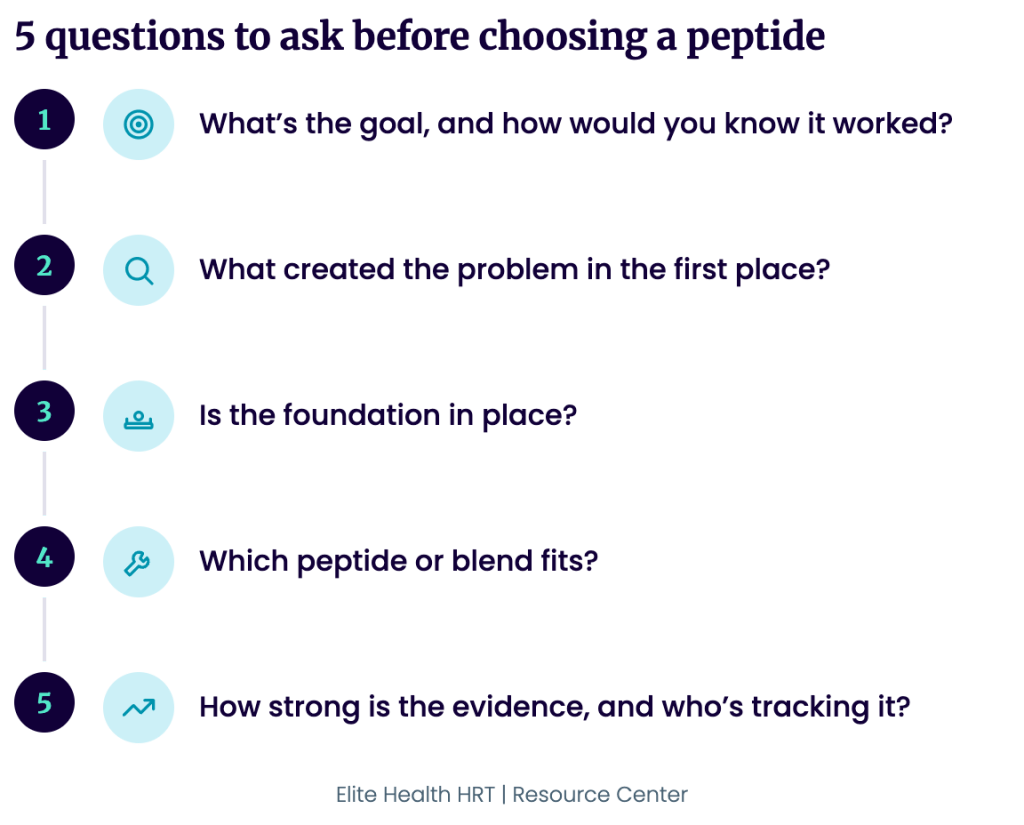
Here’s where it gets interesting. And there’s a lot more to it than just picking a peptide off a menu because it sounds good. As you read on, you’ll learn about the basic mechanics of some of the most popular peptides on the market. We’ll spend most of the time exploring 5 questions you can explore with your provider as you consider peptide therapies
Let’s get to it.
This is worth clearing up. A goal doesn’t have to be a complaint.
Here’s what we mean. Plenty of people come to clinics like ours with something clearly wrong. Then, there are others who are ‘already doing the right things’ – but are looking for a bit more out of it. Both are fair and legitimate reasons to consider peptide therapy, and the questions below apply either way.
That said, sometimes goals are too vague to act upon immediately. For instance, “I want better recovery” is more of a category, not a target. Recovery from a specific shoulder injury, recovery from a training volume you’ve recently doubled, and recovery to compensate from only sleeping five hours a night are three different problems. Only two of them point anywhere near using a peptide like BPC-157
So the first job is sharpening the focus. What specifically bothers you, how long has it been going on, and what have you already tried? And what would “better” actually look like ten weeks from now?
With hormones, bloodwork does much of the heavy lifting. Total and free testosterone, estradiol, progesterone, thyroid markers, and others give us numbers to work from and numbers to benchmark against later.
However, numbers alone are never the whole picture. For example, two women can come in with nearly identical estradiol and describe two completely different experiences. One may have no issue sleeping through the night and feeling steady, while the other frequently wakes up at 3am and experiences brain fog into the afternoon. The same can hold true for two men at matching testosterone levels and similar ages and health backgrounds.
We think of it as building a case. Factors like labs and symptoms are evidence. Lifestyle factors, like how you’re sleeping, training, recovering, and thinking are all evidence as well. Good judgement stems from weighing all of it.
Why does this matter more with peptides than with hormones? It’s because various peptides fall on a spectrum when it comes to what labs can show you.
At one end, labs point directly at what’s happening. Kisspeptin, a peptide used for fertility in men and women, is a good example here. It acts upstream on a hormone called GnRH. Then, GnRH signals the production of two additional hormones called LH and FSH. LH and FSH both are measurable on a lab panel, so we can track progress with repeat labs.
For other peptides, labs give a useful proxy. For instance, sermorelin, CJC-1295 with ipamorelin, and tesamorelin don’t have markers of their own. However, IGF-1 tracks the growth hormone axis they’re acting upon. It isn’t the compound, though it’s a real indicator of what the compound is doing.
At the opposite end, no marker exists at all. Peptides used in helping foster focus and recall like Selank & Semax both serve as a good example. They upregulates brain cells that are responsible for making a compound called BDNF. BDNF is what’s known as a neurotrophin, and it plays an important role in learning and memory. The problem is there’s no cost-effective BDNF panel on the market today. Judging progress is much more subjective and requires discernment from the patient.
BPC-157 is another example. Remember that peptides are chains of amino acids. And BPC-157 is a short fragment of a much larger protein molecule that’s found in gastric juice. Thing is, nothing on standard bloodwork measures it. You can’t order a BPC-157 panel because one doesn’t exist.
When the compound itself isn’t measurable, you don’t stop measuring. You move the measurement to the outcome. This often includes datapoints like visceral fat and skeletal muscle mass from InBody scans. Or, it could be things like waist circumference, the weight on the barbell, sleep data, energy through the afternoon, or simply how a nagging joint is feeling.
Let’s say a goal is to reduce visceral fat. This is almost always a worthy target because visceral fat wraps around organs in your abdomen and it’s known for releasing inflammatory chemicals into your bloodstream. In many ways, it acts like a new organ – albeit not a very helpful one.
So if an InBody scan flags visceral fat to be in a range worth taking seriously, that number can be used as a benchmark as time goes on. You might explore and consider a 10-week peptide protocol with peptides like AOD-9604 or tesamorelin (both of which are in Elite Health HRT’s Fat Burner Blend).
Other goals follow the same logic. If you’re looking to rebuild lean mass, skeletal muscle measurements on the InBody paired with how much weight is on the barbell tells the story.
For sleep, it’s your sleep data next to how you feel at eleven in the morning. And for focus and mood, it’s an honest weekly note measured against how you described things on day one.
From there, you can track that number as the weeks go on. And if it isn’t moving the way you expected, that itself tells you something worth knowing.

This is a question that’s easy to skip. The thing is, it’s also the one that determines whether a peptide has a proper chance to work.
Go back to that visceral fat number. If a sedentary routine, a steady calorie surplus, and five hours of sleep a night built it up over three years – then a ten-week protocol on its own won’t dig you out of the hole. Your body still needs the right supporting conditions for peptides to do their job.
Recovery works the same way. Most of your repair happens while you’re asleep, so a recovery peptide like BPC-157 will fight an uphill battle if you’re only sleeping 4-5 hours a night.
The same logic runs well outside body composition. Someone struggling with stress and concentration might reasonably look at a cognitive peptide. However, if they’re spending four hours a day endlessly scrolling news and social media, the missing input probably isn’t a peptide.
Low libido can be viewed through the same lens too. While it can easily stem from hormonal imbalances, it can just as easily come from chronic stress, thin sleep, and a schedule with nothing left in it.
In our clinic, this is a real conversation, not a formality. We’ll talk through controlling calories while keeping protein high enough that what you lose is fat rather than muscle. We’ll talk about strength training and practical movement, including something as unglamorous as getting from three thousand steps a day to eight. We’ll talk about what’s disrupting your sleep and which supplements and tactics tend to help.
None of that is filler. Every one of those factors is either working with the peptide or against it.
There are two acceptable answers to this question, and that’s worth saying plainly. Some people work through it and find something worth addressing first. Others work through it, find nothing, and confirm their foundation is already solid. That second answer is a green light, not a disqualification.
The short version is that peptides don’t replace lifestyle. They multiply it.
Here’s where bloodwork earns its keep a second time.
In the first question, labs were how you measured whether something worked. Here they answer something else entirely – whether the goal is realistic to begin with. Same panel, different question.
For an example, imagine a woman in her late forties whose sleep has come apart over the past year. She’s snapping awake at three in the morning and is slow to recover from exercise she used to bounce back from. On top of that, she’s carrying weight around her midsection that wasn’t there before.
In this case, a sleep peptide is a reasonable thing to be curious about. But what about hormones? If progesterone levels are declining, that could be a likely cause for sleep fragmentation. When coupled with estrogen fluctuations and other imbalances, it’s an uphill battle for a peptide to provide meaningful relief or progress.
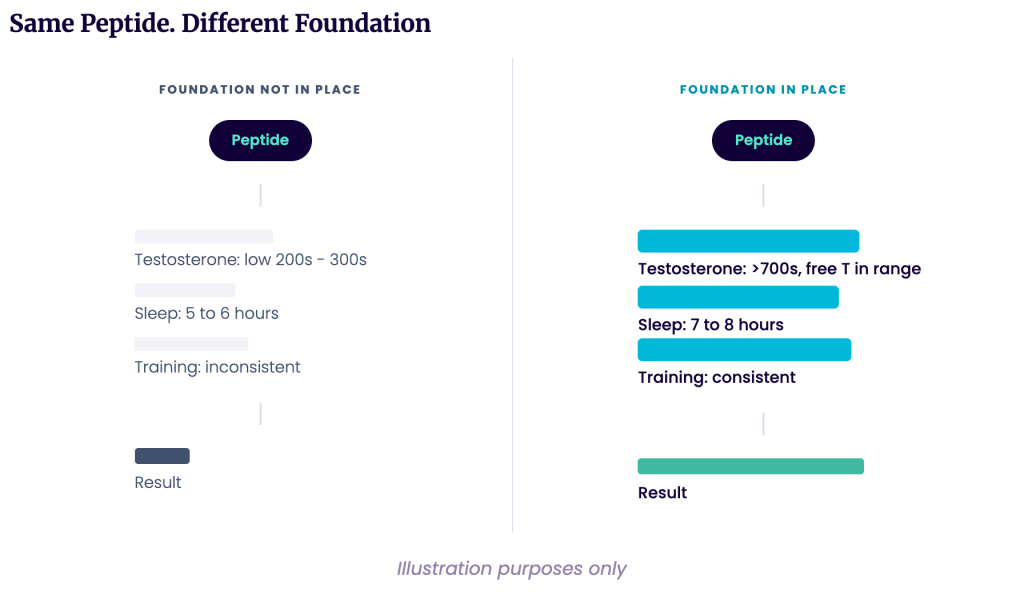
The same principle runs on the men’s side, and the numbers make it especially clear. Say a man’s goal is adding five pounds of lean muscle. We’ll also say he’s training seriously, eating enough protein, and sleeping decently. But, his total testosterone sits in the low 200s ng/dL.
In this case, a peptide is unlikely to give him much leverage because the hormonal foundation for building muscle simply isn’t there.
Now bring that same man into the 800-1200s ng/dL or higher with free testosterone in a genuinely usable range. Same training, same nutrition, same peptide. The odds would favor a much different outcome.
This underscores why we treat hormone therapy for women and testosterone therapy for men as foundational measures. Hormone levels shape what every other intervention is capable of doing.
Hormones set the ceiling. Lifestyle and habits determine whether you get anywhere near it.
Think of it this way. If you started a protocol next Monday, would the ten weeks that follow give it something to work with?
Are you moving at all – and is any of it resistance training? Is protein anywhere near where it should be? Is your sleep consistent rather than occasionally good? Is stress at a level you’re actually managing?
It’s not like you need to live a Spartan lifestyle and be 100% disciplined every single day. Still, it never hurts to audit where you might be able to make small adjustments that can stack up over time.
After arriving at an answer for the first three questions, this one gets much easier.
Most assume this is where you learn how to choose a peptide, scanning a menu list of compounds and picking whichever sounds closest. In practice it works the other way around. By now you’re not picking from a menu at all. You’re matching a mechanism to a goal you can finally describe precisely.
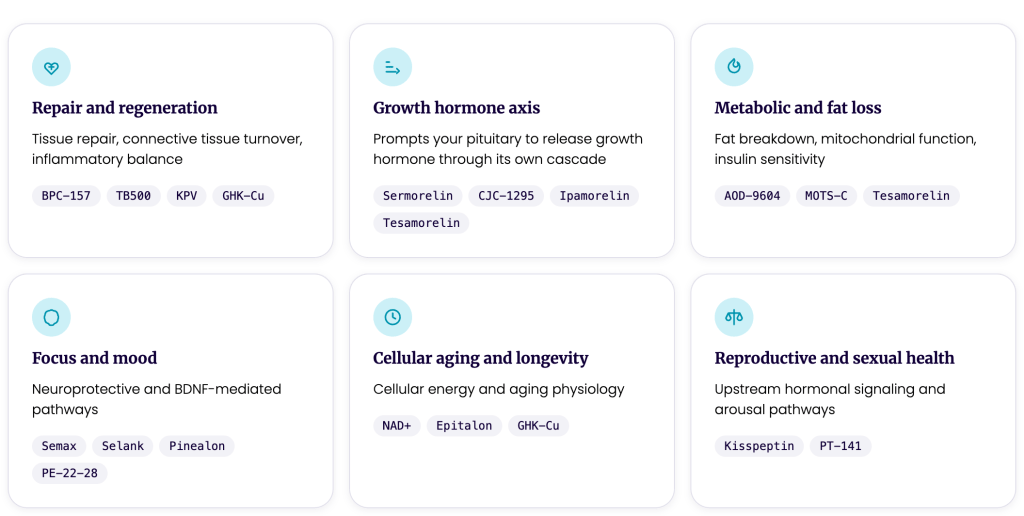
The peptides we work with sort into a handful of groups. Each group has a similar ‘mechanism of action’ – which refers to how it works in the body.
Repair and regenerative signaling is where BPC-157, TB500, KPV, and GHK-Cu come in. They have promising evidence for their role in tissue repair, connective tissue turnover, and inflammatory balance. Our article on recovery and sleep peptides covers that group in depth.
A larger cluster works through the growth hormone axis. Peptides like sermorelin, CJC-1295, and ipamorelin prompt your pituitary to release growth hormone through its own cascade rather than replacing it directly.
Tesamorelin does something similar while carrying the strongest research in our catalog for reducing visceral fat in particular. For that reason, it also appears alongside AOD-9604 and MOTs-C in the Fat Burner Blend. Those three influence fat breakdown, mitochondrial function, and insulin sensitivity by different routes. The performance article gets into how they differ.
Semax, Selank, Pinealon, and PE-22-28 act on neuroprotective and BDNF-mediated pathways. That’s a fancy way of saying they help support cognitive function. We explore further in the article on focus and mood.
Then there’s peptides like NAD+, Epitalon, and GHK-Cu. These work on cellular energy and aging physiology – further covered in our longevity piece.
Kisspeptin and PT-141 both have a part reproductive health, though from opposite directions. Kisspeptin works upstream on the hormonal axis itself to support fertility, while PT-141 acts through arousal pathways in the brain.
Most of what we offer comes as a blend, and the reason is mechanism rather than marketing.
The Recovery Blend pairs BPC-157 with TB500, KPV, and GHK-Cu because each acts on a different stage of the same repair process. The Sleep Blend combines DSIP with CJC-1295 because deep sleep and nighttime growth hormone release happen in the same window, so supporting one supports the other.
The mistake worth avoiding isn’t blends. It’s self-directed stacking, where someone adds three unrelated compounds at once because each sounded good on its own. When something improves, you can’t tell which one did it. When something feels off, you have no way to isolate it. A designed blend is a decision somebody made deliberately. A stack assembled out of enthusiasm is three decisions nobody made.
Here’s why this question needs a conversation rather than a menu. Picture someone training hard with their foundation already in place, wanting recovery to keep pace with the work. They could go at it directly with BPC-157 or the Recovery Blend. They could target lean mass with the Build Blend. Or they could come at it from the opposite direction with the Sleep Blend, deepening sleep so recovery improves on its own.
All three are defensible. Which one fits depends entirely on where the bottleneck sits, and that isn’t something you can determine from a product page.
Here’s what most clinics won’t say out loud regarding peptides when it comes to formal, large-scale clinical trials.
Peptides have not been studied the way GLP-1s have, or the way conventional medications like metformin and blood pressure drugs have. One major reason is that it’s extremely difficult for large pharmaceutical companies to patent peptides. For competitors, it’s relatively easy to make a very small adjustment to a molecule, which technically then makes it a completely different compound. Today’s patent laws don’t quite account for this.
As an effect, there’s much less of an incentive for companies to fund large-scale studies. It’s also why peptides don’t work their way through FDA regulations for approval.
So what evidence does exist? For the most part, there’s a mix of animal research and well-characterized mechanisms. There’s also a consistent stream of patient-reported outcomes. You might hear podcasts refer to this as ‘anec-data’.
The conclusion most people draw from that is the wrong one, though. A thinner evidence base isn’t necessarily an argument against peptides. It’s actually the strongest argument there is for proper supervision.
Think about what published research normally does for you. It tells you roughly what to expect, in whom, and over what timeframe. When that body of evidence is thinner, the substitute is measurement on your own body. Bloodwork every 90 days, InBody scans tracked over time, and symptoms compared against the baseline you wrote down.
Another key is working with a provider who can adjust your protocol based on what’s actually happening.
To be fair about the risk itself: pure, accurately-dosed, sterile peptides from reputable U.S. compounding pharmacies aren’t sending people to the hospital with any sort of regularity. The hospitalizations we described in the last article almost always come from poorly sourced peptides.
Now, let’s be clear that supervision alone doesn’t mean absolute elimination of any adverse effect. However, the same can be true of almost any medication.
One more piece belongs here before we wrap up, and it’s worth being specific about.
These compounds aren’t inherently dangerous, and they aren’t known to cause cancer. Let’s not overstate it. The concern is narrower than that. Growth hormone and IGF-1 signaling is, by definition, growth signaling. So for someone with a cancer history, the Build Blend and the growth hormone secretagogues warrant a real conversation rather than a default yes.
A few other situations call for the same care. Pregnancy and breastfeeding rule out most peptide protocols outright. Blood pressure that isn’t well controlled is worth sorting out before considering PT-141. And anyone managing diabetic retinopathy should talk through the growth hormone secretagogues carefully with their provider.
It doesn’t necessarily mean avoiding peptides entirely, forever. It’s the reason the conversation starts with your health history – and not with a product page on a research chemical website (unless of course you’re experimenting on lab mice).
Peptides are tools. A good tool earns its keep when it’s matched to the right job, used correctly, and supported by everything around it. The same tool does very little when the foundation it’s working on isn’t strong.
That’s really what these five questions are for. Define the goal and how you’d measure it. Understand what created it. Make sure your hormones and habits give it room to work. Match the mechanism. Then stay in the loop with someone tracking it alongside you.
Notice that only one of those five steps involves naming a compound. Figuring out how to choose a peptide is mostly the work you do before the compound ever enters the conversation.
At Elite Health HRT, your first consultation is free at both our Roswell and Hickory Flat locations, and that visit includes an InBody scan so you have a baseline from day one. Comprehensive labs run around $150. Every follow-up visit with our nurse practitioners is free, and we review repeat labs every three months. All of our peptides also come from licensed U.S. compounding pharmacies.
If you’re weighing peptide therapy seriously, book a free consultation at one of our North Atlanta locations. Bring these five questions with you. We’ll work through all of them together.
Serving patients in North Atlanta: free 15-minute consult with licensed provider
Free digital 25+ page ebook with over 1,000 downloads
Not in the way there is for hormones. With testosterone or estradiol, the number effectively names the treatment. Peptides vary. Kisspeptin’s effect shows up in LH and FSH, and the growth hormone secretagogues can be tracked through IGF-1. For others, including BPC-157, Semax, and Selank, no lab marker exists at all. Bloodwork still matters, though its job is usually establishing whether your foundation supports the goal, rather than pointing at a specific compound.
No. Some of the best candidates we see are people whose labs look solid and whose habits are already good. If your training is consistent, your sleep is decent, and your hormones are in a healthy range, a peptide has more room to work rather than less. The framework in this article applies either way. It just moves faster when your foundation is already in place.
Often, yes, and most of what we dispense is already a blend built around complementary mechanisms. The distinction is between a combination somebody designed and a stack you assembled yourself. Starting three unrelated compounds at the same time makes it nearly impossible to know what helped, what did nothing, and what caused a side effect.
It depends on the goal. Sleep and energy changes often show up within a few weeks. Body composition and tissue repair take considerably longer, typically a couple of months before the change is measurable. This is exactly why we push for a written baseline and a defined checkpoint. Without those, ten weeks passes and everybody is guessing.
Then we’ll explain why and talk it through. Usually one of two things is happening. Either the compound is aimed at a mechanism that doesn’t match what’s actually limiting you, or something in your labs or history makes a different option a better fit. You’re welcome to disagree with us. What we won’t do is hand over a compound because it was requested by name, without a reason behind it.
Did you find this article helpful or informative? Consider spreading the word!
Subscribe now to keep reading and get access to the full archive.