920 Woodstock Rd, Roswell, GA 30075

Protein isn’t just about building biceps or looking like a bodybuilder at the beach. Sure, those things are nice. But it’s really about staying functional, mentally sharp, and physically lean as you age. In this article, we’re answering the question of how much protein do you need in proper detail.
Aside from talking through grams per day, we address why it matters more than you might think & show practical examples of what a day of high-protein eating actually looks like (spoiler: no fake meat or overly processed protein bars involved).
This article is the first part of our Body Recomposition Series, which offers a no-nonsense look at how to burn fat, build muscle, and improve longevity (with less guesswork and more results). Be sure to check out our next articles on how to beat cravings and practical exercises.
In classic fashion, the internet and social media does a nice job at making nutrition way more confusing than it needs to be. Protein is no exception – and it’s one of the more misunderstood aspects of diet. That’s partly because for years, we’ve been bombarded with nonsense studies and corporate-sponsored ‘science’. Ever see red meat depicted as highly dangerous, or eggs portrayed as cholesterol bombs?
Meanwhile, the same type of scientists also champion highly-processed “plant meats” as the future of food. If you’ve ever thought, “Hmm.. this doesn’t quite add up,” you’re right.
Here’s the deal. Eating enough high-quality protein is one of the best things you can do for your lifespan (years of your life) and healthspan (life in your years). Sure, aesthetics are a plus – but don’t miss the big picture. Now if your main goal is impressing others at the gym, no judgement here. Just don’t forget the merits of avoiding brittle bones and muscle loss as you age. And don’t overlook the value of stabilizing blood sugar, controlling cravings, and simply maintaining independence when you get older – because we all do.
Remember how your parents told you to eat vegetables as a kid? Sure, we support that too. But if you want to look, feel, and function better long term – eat your protein!
You’ve probably heard the conventional advice of “just eat more protein” before. Thing is, people rarely explain why. And what if you’re not just trying to add lean muscle? What if you’re just trying to age gracefully, get leaner, or stay in shape in your 50s & 60s?
Let’s start with what protein actually does.
Protein is the raw material your body uses to rebuild and maintain muscle, skin, organs, and connective tissue. Whether you’re strength training, recovering from a tough week, or even healing from surgery – protein is essential for structural support and regeneration.
Proteins are the building blocks of enzymes and many hormones. That means they directly impact your metabolism, energy levels, digestion, mood, and even sleep. If your protein intake is low, those systems start to lag.
Your immune system relies on protein to produce antibodies and carry out detox processes. A protein-deficient diet can compromise your ability to fight off infections or bounce back after illness
Strong, elastic skin. Thick hair. Healthy nails. These are all protein-dependent. Think collagen, keratin, and elastin – you need all three for healthy aging. And guess where they come from? Protein intake.
If you’ve had surgery or suffered an injury, your body goes into overdrive trying to repair the damage. Protein provides the amino acids needed to rebuild tissue, reduce inflammation, and speed up recovery.
To the point here. This is the question everyone asks – how much protein do you need to eat every day?
You could take the government’s RDA (recommended dietary allowance), which says you need roughly ~0.36g of protein per pound of bodyweight. So for a 180 lb man – that’s 65g per day. As you might imagine, this is inadequate if you want to thrive.
Or, you could take the gym bro advice and eat 1g of protein per pound of overall body weight, per day. If you’re not a professional athlete, that’s unnecessary.
To keep things in a realistic range, we recommend .7g – 1g of protein, per pound of lean body mass, per day. That begs the question, “What’s lean body mass, exactly?”
This is the sum of:
Now, you can’t exactly step on the average scale and get a reading on this. Luckily, as an Elite Health HRT patient – you can get a printout of this during your next visit to the clinic using the InBody scale. If you’ve already gotten one, you can see lean body mass at the top of your printout (or in the InBody app if you’ve downloaded it).
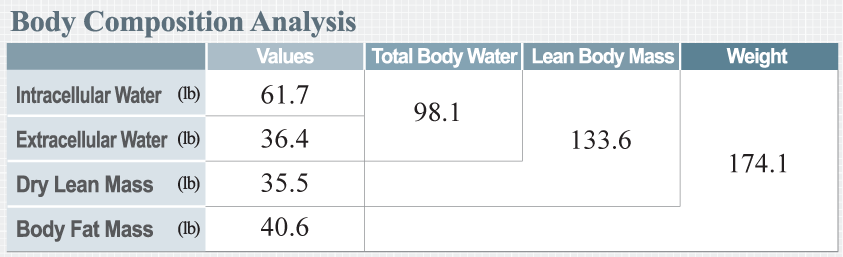
As a reminder, there’s no charge for active Elite Health HRT patients to use the InBody. You only need to ask our team during our next visit.

Our Fat Burner Blend (AOD-9604, MOTS-c, Tesamorelin) works with your protein intake—helping the body burn fat more efficiently while preserving lean muscle.
It’s a smart add-on for anyone focused on body recomposition or dialing in results from their training and nutrition.
Ask us if it fits your goals, or tap below to learn more.
People tend to criticize eating more protein in general and often overlook the risks of not consuming enough. Let’s address what usually goes overlooked.
We don’t intend to be alarmist, but it’s important to understand the vicious cycle many Americans find themselves stuck in.
Now, you can’t exactly step on the average scale and get a reading on this. Luckily, as an Elite Health HRT patient – you can get a printout of this during your next visit to the clinic using the InBody scale. If you’ve already gotten one, you can see lean body mass at the top of your printout (or in the InBody app if you’ve downloaded it).
Nutrition labels make it easy to think that all protein is created equal. However, that’s not quite the case. 30g of protein from pasture-raised chickens or grass-fed cows offers superior nutritional value to 30g of protein from a highly processed protein powder or plant-based ‘meat’.
When in doubt, opt for whole foods like:
Now that we’ve answered the question of, “How much protein do you need?” it’s only natural to wonder, “Well, what if you eat too much protein?” Let’s address the top 3 (receipts included).
If you have healthy kidney function already, evidence demonstrates that eating more protein is perfectly safe. This study concluded that, “…it appears that protein intake under 2.8 g/kg does not impair renal function in well-trained athletes” (Poortmans & Dellalieux).
And if you’re not an active athlete? This study concluded that higher protein intakes do not adversely impact kidney function in healthy adults (Devries)
To be clear: If you have have an underlying kidney condition – talk to your doctor before increasing protein intake. The point here is that increasing protein isn’t going to cause damage that wasn’t already there.
This myth originated from the “acid-ash hypothesis” of the 1970s-90s. Basically, the theory goes like this:
The logic sounds simple: eat more than you need, store the rest as fat. But protein doesn’t work like carbs or dietary fat. It’s not easily stored – your body has to convert it into glucose first. This process actually burns energy and only happens when needed.
Even then, glucose is usually used to refuel your brain, muscles, or liver glycogen, not turned into fat.
Researchers tested this hypothesis in resistance-trained individuals and measured what would happen if they ate a whopping 4.4g of protein per pound of bodyweight, per day. It concluded, “There were no changes in body composition despite consuming more calories & protein” (Antonio et al).
We saved the best myth for last here. Your body absorbs nearly all the protein you eat, even if it’s more than 30g.
When you hear about the “30g limit” – it’s referring to muscle protein synthesis (MPS). And MPS is the amount of protein your body needs to repair & build muscle.
As we established earlier, protein does much more than just build & repair muscle. So if you eat a steak with 50g of protein – it’s not as if your body flushes the rest out of your system.
Instead..
If you skimmed to the bottom for a summary, here’s the quick version:
Most adults need 0.7–1.0g of protein per pound of lean body mass, daily
The government RDA (~0.36g/lb) is designed to prevent deficiency, not optimize performance or healthspan
Use your InBody scan results to personalize your daily protein target
Prioritize whole-food sources like grass-fed meats, wild fish, eggs, and high-quality dairy
Protein isn’t just for muscle.. it supports hormones, immunity, blood sugar, and aging well
If you’re still dialing in your protein intake, you probably have a few questions. Let’s talk through the common FAQs.
Q1. How much protein do I need per day?
For body recomposition and healthy aging, Elite Health HRT suggests roughly 0.7 to 1.0 gram of protein per pound of lean body mass daily. This is higher than the government RDA of about 0.36 grams per pound, which is set to prevent deficiency rather than optimize muscle, metabolism, and recovery.
Q2. Is the RDA for protein enough to build muscle?
The RDA of roughly 0.36 grams per pound is designed to prevent deficiency, not to optimize muscle or performance. If your goal is building lean mass, protecting metabolism, and aging well, most people benefit from more. Elite Health HRT points patients toward 0.7 to 1.0 gram per pound of lean body mass instead.
Q3. Should I calculate protein by total body weight or lean body mass?
Elite Health HRT recommends basing protein targets on lean body mass rather than total body weight, since muscle drives your needs. Active patients can measure lean mass on the clinic’s InBody scale at no charge, giving a more accurate starting number than guessing from scale weight alone.
Q4. Does eating too much protein damage your kidneys?
Not if your kidneys are healthy. The concern traces back to patients with existing kidney disease, where protein restriction is genuinely part of treatment, and it got generalized to everyone. Higher intake does raise filtration rate, but that’s the kidney adapting to a bigger workload rather than being harmed by it. If you have diagnosed kidney disease, that’s a real conversation. Otherwise it isn’t one.
Q5. Can high protein intake cause weak or brittle bones?
Current research does not support the idea that higher protein weakens bones. Research shows that excess calcium excretion from higher protein intake does not appear to cause bone mineral loss. Adequate protein actually supports muscle and skeletal health, which matters more as you age.
Q6. Does extra protein just turn into fat?
Protein is not easily stored as fat. The body does not readily convert it, and any surplus must first be turned into glucose. Protein is also used for enzymes, hormones, immune function, and tissue repair, so it is prioritized for many jobs before excess becomes a concern.
Q7. Can your body only absorb 30 grams of protein per meal?
No, this one is a persistent myth. You absorb essentially all of it – the 30 gram figure came from studies on how much maximally stimulates muscle protein synthesis in one sitting, which is a different question from absorption. Recent work suggests even that ceiling is higher than assumed. Spreading protein across meals is still practical, just not because anything gets wasted.
Q8. What are the best protein sources?
Elite Health HRT favors high-quality animal proteins: grass-fed beef, bison, and lamb, wild-caught fish, pasture-raised eggs, and organic poultry, plus quality dairy like Greek yogurt, kefir, and cottage cheese. The clinic suggests avoiding processed deli meats and heavily processed plant-based meat alternatives.
Q9. How can I measure my lean body mass at Elite Health HRT?
An InBody scan. It takes about a minute, you stand on it holding two handles, and it separates your weight into lean mass, fat, and water. That number is what sets your protein target, since scale weight alone can’t tell you what you’re feeding. The scan is free, and we repeat it at follow-ups so you can see which direction each of those is moving.
That’ll do it for our deep-dive on answering, “How much protein do you need?” In the next article in our Body Recomposition Series, we’ll cover:
Why your body craves sugar and carbs (even when you “know better”)
How protein, blood sugar, and gut hormones like GLP-1 affect hunger signals
Practical strategies to reduce cravings.. without relying on stimulants or sheer willpower
When cravings are under control, consistency stops feeling like a grind – and results actually stick.
👉 Keep reading: “How to Beat Cravings (And Actually Stick To Your Diet)”
Did you find this article helpful or informative? Consider spreading the word!
Subscribe now to keep reading and get access to the full archive.