
920 Woodstock Rd, Roswell, GA 30075
As we cap off our mini-series of foundational articles about peptides, let’s recap all the ground we’ve covered.
In our first article, we discussed at length how peptide signaling works within the body. Then we explored the different peptide supply chains – mainly focusing on compounding pharmacies, research chemicals, and the black market. And in the last article, we gave a proper introduction to many of the popular peptides you’ll come across. We also shared questions you can ask your provider as you select a peptide for your needs as a patient.
Next up, we’re digging into a question that is easy to overlook if you’re not familiar with peptide therapy.
Why can’t you just take peptides every day? If you’ve settled into hormone therapy and can take that every week, why would peptide cycles work differently?
For those starting peptide therapy, it’s important to adhere to a dosing protocol that makes sense for you and that specific peptide. At our clinic, that usually looks like a 10-week regimen with what’s referred to as “5 on, 2 off” dosing. That simply means 5 days in a row, 2 days off.

Hormone therapy for women and testosterone therapy for men do exactly what the name says. Your body isn’t producing enough of a hormone, so we replace what’s missing. That’s a supply problem. And supply problems don’t resolve on their own, which is why you stay on a dose rather than cycling off it. If you were to stop the therapy, levels would return to where they started.
Here’s what makes peptides different. They aren’t replacing anything. As you recall from the first article, peptides are signaling molecules. And this means they tell a system in your body to work differently. As an example, sermorelin doesn’t directly replace growth hormone. It asks your pituitary to release more of your own.
That distinction changes everything about how you use them. You can’t fatigue a system by giving it a hormone it lacks. However, you absolutely can fatigue a system by leaning on its signaling pathway without ever taking a break.

Here’s the part that reassures most people. The results of a cycle don’t evaporate when the vial runs out.
Muscle you built during a run of the Build Blend is muscle you have. Visceral fat you lost is gone. A shoulder that healed is healed. These are structural changes, not levels being propped up.
Take a woman in her early fifties who spent ten weeks on a sleep protocol and finally started getting through the night. The peptide didn’t install a permanent fix. But by week ten she’s training consistently again, her afternoons aren’t a fog, and her habits have reorganized around actually sleeping. That will often carry forward.
So back to the first question of, “Why can’t you take peptides every day?” The weekly break isn’t padding. It’s there by design, and it keeps the signal sharp.
Many peptides work by binding to receptors on the surface of your cells. That’s the lock and key from our first article. What that analogy doesn’t tell you is what happens when the key never leaves the lock.
Receptors are built to respond to change rather than to a constant. You’ve felt this yourself. Walk into a room with a strong smell and you notice it right away. Twenty minutes later you can’t detect it at all, even though nothing about the room has changed. Your receptors adapted to a signal that never varied.
A peptide arriving every single day gets treated the same way. Biologists call it receptor downregulation. The cell physically pulls receptors off its surface, or keeps them and stops responding as strongly to each one. The peptide is still showing up – the cell just isn’t listening the way it was.
Two days off is enough to reverse that. It’s a small reset, repeated weekly, and it’s why a well-run protocol tends to feel as effective in week nine as it did in week three.

There’s a second layer to this. The body’s signals aren’t meant to be switched on all the time. The growth hormone axis makes for a good example here.
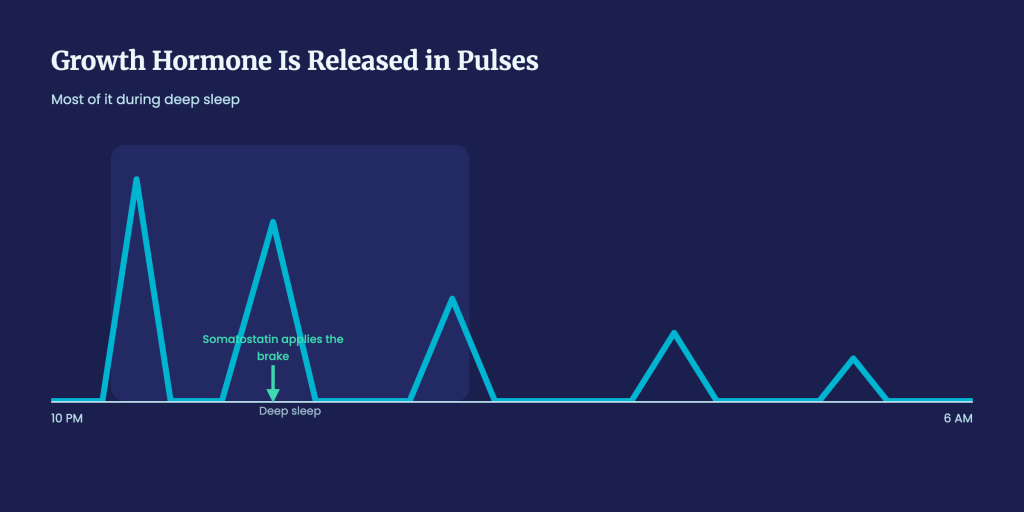
Your body doesn’t release growth hormone in a steady stream. On its own, it naturally releases it in pulses – most of them at night during deep sleep. There’s also a ‘brake’ in the system, which is a hormone called somatostatin which opposes GH release and keeps the axis in check.
That pattern isn’t an accident. The compounds in our Performance Blend are built to work with it rather than override it. Push the pathway continuously and two things happen. The receptors get less responsive, and the brake gets applied harder.
Here’s something that rarely comes up, even in good coverage of this topic. Not every peptide has a cell receptor anyone can point to. So if a cell doesn’t have a receptor for a peptide molecule, how does the peptide work at all? And why would you have to use a peptide cycle?
A receptor is the entry point, not the effect. Remember learning about cascades in the first article? A receptor takes in a message and kicks off a chain of events inside the cell.
Peptides without a known receptor just enter that chain further along. BPC-157 is the clearest example. While scientists have not identified a receptor for it, the molecule appears to modulate pathways you already have running. This includes things like growth factor signaling and the formation of new blood vessels. TB500 and MOTs-C are two other peptides that exert effects without attaching to a receptor.
As for why you’d still run these in cycles, part of the answer is plain honesty. For several of these compounds, the cycling convention comes from clinical practice and observed patient response, rather than from a fully mapped mechanism. That’s the evidence base we described in the last article. With something like BPC-157, you can’t point to the receptor and you can’t order a lab that measures it. That’s what makes the structured stop matter more here, not less.
The weekly rhythm and the cycle length solve different problems.
Sleep and energy changes often show up within a few weeks. Body composition and tissue repair take considerably longer. Ten weeks covers both, which means when you get to the end you have something to actually look at rather than a vague sense that things are maybe better.
It also matches how the medication is dispensed. A vial arrives as a full ten-week supply rather than as individual doses, which is why peptides feel more expensive upfront than a weekly hormone shot even though the three-month cost lands in a similar place.
The rhythm does shift by compound. PT-141 for libido is used as needed rather than on a schedule. There are other one-off exceptions to the rule. Your protocol should come from a provider looking at your specific plan.
Sometimes the job is simply finished.
Tissue repair is the clearest case. Someone running the Recovery Blend for an ankle that never came back after a bad sprain has a specific target. When the ankle holds up under load and stops aching the next morning, the peptide has done what it was brought in to do. Continuing indefinitely isn’t caution – it’s spending money on a problem you already solved.
Fat loss works similarly. If an InBody scan flagged high visceral fat levels at the start and the Fat Burner Blend moved that number into a healthier range ten weeks later, the next question isn’t whether to keep going. It’s whether your habits will hold the result.
That wraps our peptide foundations series. Across four articles we covered how peptides signal, where they come from, how to choose one, and now how to run it.
The last piece is the simplest to state. Ten weeks on, five days a week with two off. Then you measure, you look at what actually changed, and you decide with your provider whether another round makes sense. That structure isn’t a limitation on peptide therapy. It’s what keeps peptide therapy honest.
At Elite Health HRT, your first consultation is free at both our Roswell and Hickory Flat locations, and that visit includes an InBody scan so you have a baseline before anything starts. Comprehensive labs run around $150. Every follow-up with our nurse practitioners is free, and we review repeat labs every three months. All of our peptides come from licensed U.S. compounding pharmacies rather than the gray market.
If you’re thinking about a cycle, book a free consultation at one of our North Atlanta locations. We’ll build the protocol around your labs and your goal, and we’ll be there at week ten to look at what happened.
Serving patients in North Atlanta: free 15-minute consult with licensed provider
Free digital 25+ page ebook with over 1,000 downloads
Not the structural ones. Muscle you built, fat you lost, and tissue that healed are real changes that stay unless you rebuild the conditions that caused the problem. What can fade are effects that depend on ongoing signaling, like sleep quality or energy, and even those often hold for a while because habits reorganize around feeling better. This is a meaningful difference from hormone therapy, where levels return to baseline fairly quickly after stopping.
It depends on the compound and how the first cycle went. The purpose of the break is to let the pathway reset and to see how your results hold without support, so the length gets set against your goal rather than by a fixed rule. We work this out at the end-of-cycle review.
That misunderstands what the break is doing. Adaptation is driven by continuous stimulation of the pathway, not by dose size alone, so a smaller daily dose still keeps the signal on without a pause. You end up with a weaker effect and the same adaptation problem.
Bring it to your follow-up. Sometimes another cycle after a washout is exactly right, especially if the numbers show more room to gain. What we won’t do is run a protocol indefinitely just because it’s going well, since that’s the setup where the effect quietly fades and nobody can tell why.

Did you find this article helpful or informative? Consider spreading the word!
Subscribe now to keep reading and get access to the full archive.