
920 Woodstock Rd, Roswell, GA 30075

For many adults, life has a way of getting in the way of a good night’s sleep.
Everyday stressors elevate nervous system activity and increase inflammatory demand. At the same time, they often disrupt the very thing that restores the body and mind: deep, stable sleep.
No matter how much today’s culture rewards sacrificing sleep, it’s still our best tool when it comes to recovery and healing. Tissue repair, inflammatory regulation, and nervous system recalibration all take place during this window.
When stress disrupts sleep, recovery capacity narrows. Fatigue accumulates. And minor injuries seem to linger. Then, a cycle begins where physical and mental wear compound and eventually lead towards burnout.
The peptides discussed in this article are structured tools that may help interrupt that cycle. Improving the quality and consistency of sleep creates a “rising tide” effect — expanding recovery capacity and making daily demands more manageable.
In this article, we examine various peptides for recovery and sleep that are offered in our clinics:
Let’s begin with the mainstream standout: BPC-157.
BPC-157 (Body Protection Compound-157) is a synthetic peptide derived from a protein the body naturally produces in the stomach.
Originally, BPC-157 was studied for its ability to help support healing in the lining of the stomach and intestines.
In recent years, BPC-157 has emerged as one of the top peptides for recovery because of its wide-ranging effects in the body. This includes:
Because of these effects, BPC-157 is often used in recovery protocols that aim to support the body’s natural healing process instead of just covering up pain or inflammation. You can think of it as bringing in extra “repair crews” to help the body fix damaged tissue.
VEGF signaling increases → stimulates formation of new blood vessels → improves oxygen and nutrient delivery to injured tissue
Fibroblast activity increases → connective tissue cells migrate and multiply → supports tendon and ligament repair
Nitric oxide signaling improves → blood vessels function more efficiently → circulation and tissue oxygenation improve
Growth hormone receptor signaling increases → tissue repair and regeneration processes accelerate
Cell protection mechanisms activate → inflammation and oxidative stress decrease → damaged tissue is better protected during healing
As we mentioned at the beginning, sleep is one of the body’s most important recovery tools. When sleep quality declines, our capacity to recover declines with it. The inverse is also true. When we support sleep quality, we strengthen the body’s ability to repair and adapt.
In our Circadian Rhythm 101 article, we discuss the importance of deep sleep in particular. This stage of sleep is when growth hormone (GH) levels naturally peak. That surge helps trigger many of the repair processes responsible for tissue recovery and physical adaptation. We also explore this process further in our article on Peptides for Performance.
This blend is used in our clinic to support sleep quality, recovery signaling, and natural growth hormone production at the same time.
The full name for DSIP is Delta Sleep–Inducing Peptide. It’s a naturally occurring peptide produced in the brain and has been associated with deep sleep since scientists first began studying it in the 1970s.
Before explaining how it works, it’s helpful to draw a distinction from sedative sleep aids such as Tylenol PM. Sedatives typically work by suppressing wakefulness signals in the brain, which forces drowsiness. The downside is that sedation doesn’t always translate to restorative sleep. In some cases, these medications can make it harder for the body to reach deeper stages of sleep, which is why people often feel groggy the next morning even if they were “knocked out.”
DSIP works very differently. Instead of forcing sleep, it’s discussed in the context of supporting the body’s natural sleep cycle. By helping stabilize deeper sleep stages, the body may spend more time in restorative delta sleep — the phase when many of the body’s repair processes are most active.
Let’s shift to CJC-1295, one of the more commonly used peptides for recovery because of its influence on the growth hormone axis.
The phrase “growth hormone axis” can sound a little intimidating. You can think of it as the system — or assembly line — the body uses to produce growth hormone.
Why is growth hormone important?
First, growth hormone circulates through the bloodstream and helps the body repair and recover. Second, it signals the liver to produce another peptide called IGF-1.
From there, IGF-1 helps coordinate many of the body’s rebuilding processes, including muscle growth, tissue repair, and fat metabolism.
So where does CJC-1295 come into the picture?
It essentially mimics a peptide hormone the body naturally produces called growth-hormone-releasing hormone (GHRH). The key word here is releasing. GHRH is the signal the brain sends when it’s time for the body to produce growth hormone.
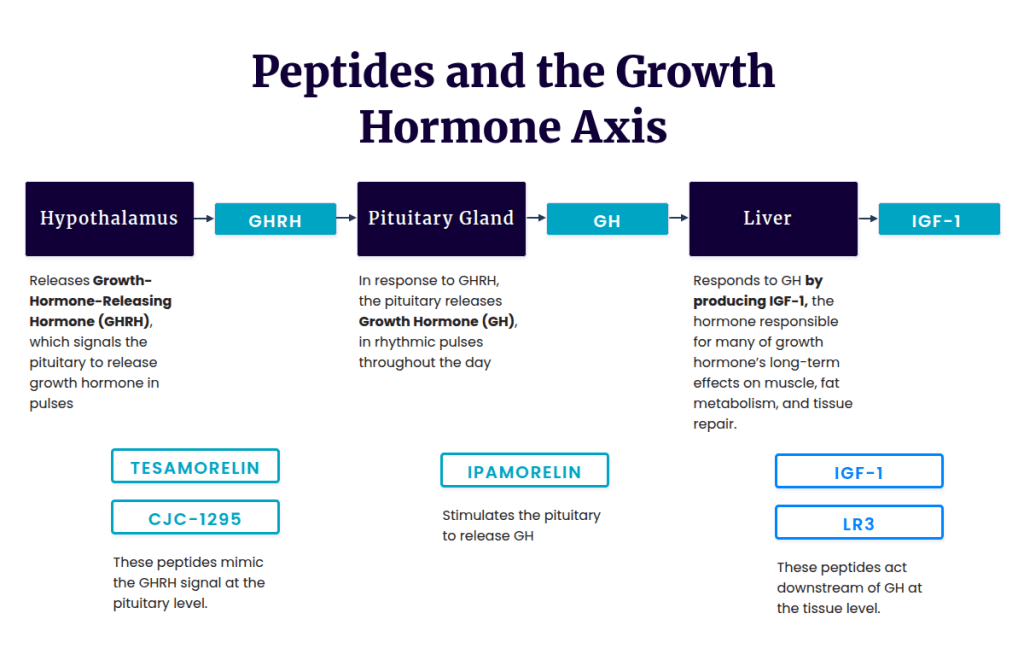
This can be a lot of information to absorb all at once. Let’s briefly recap why these three peptides for recovery and sleep are blended together:
This blend of peptides for recovery has a slightly different approach from the sleep blend we just discussed. Aside from supporting the body’s natural repair systems, it also helps regulate chronic inflammation (which otherwise impedes recovery).
In almost every cell of the body, we produce a protein called Thymosin Beta-4. It plays an important role in how the body responds to injury.
When tissue is damaged, Thymosin Beta-4 helps coordinate the early stages of repair. It supports the movement of repair cells toward injured tissue and helps regulate inflammation. It also contributes to the formation of new blood vessels that bring oxygen and nutrients to the healing area.
The peptide TB-500 is a synthetic version derived from this naturally occurring protein. It was developed to provide a more stable and concentrated version of the signals associated with Thymosin Beta-4.
In simple terms, it helps support the coordination of the body’s repair response so that damaged tissue can rebuild more efficiently.
If you research KPV online, you’ll likely see it referred to as a “fragment” of a peptide. Peptides are chains of amino acids, and a fragment simply refers to a smaller section of that chain. In this case, KPV is a fragment derived from a naturally occurring peptide called alpha-melanocyte-stimulating hormone (α-MSH).
α-MSH plays an important role in how the body regulates inflammation and immune signaling. Researchers discovered that many of the beneficial regulatory effects of α-MSH are preserved within the much smaller KPV fragment.
Here’s the gist of how KPV works. During the healing process, inflammation signals the body that repair needs to begin. But if inflammatory signals remain elevated for too long, they can slow the transition from injury response to tissue rebuilding.
KPV helps support that balance by:
To boil it down: KPV helps ensure that inflammation does its job (initiating repair) without remaining elevated long enough to slow healing.
We cover GHK-Cu in our article Peptides for Longevity, since it’s also included in another blend we offer. We’ll briefly recap it here and explain why it’s included in this blend of peptides for recovery.
GHK-Cu is another naturally occurring peptide that plays a role in the body’s repair process. Specifically, it helps stimulate the production of collagen.
When people think of collagen, hair, skin, and nails often come to mind first. But collagen plays a much broader role in the body. It provides strength and structure to connective tissues, and the body relies on it when building and repairing tissues in tendons, ligaments, cartilage, and blood vessels.
Here’s a simplified overview of the repair cycle that GHK-Cu helps support:
Think of it this way. If TB-500 helps coordinate the repair response and KPV helps regulate inflammation, GHK-Cu helps rebuild the structural “scaffolding” of the tissue itself.
Tissue repair is not a single event. It’s a coordinated process that unfolds in several stages.
When an injury or strain occurs, the body first signals inflammation to initiate repair. Then repair cells migrate to the affected area. Finally, new connective tissue is built and strengthened to restore structural integrity.
Each peptide in this blend helps support a different part of that recovery process.
Taken together, these peptides aim to support multiple stages of the body’s natural recovery cycle rather than targeting just one pathway.
In simple terms, the goal isn’t to “force” healing — it’s to help create the conditions where the body’s own repair systems can function more efficiently.
If you’re actively researching peptides, you probably still have a few questions. Let’s talk through the common FAQs.
Q1. What is BPC-157 and what is it used for?
BPC-157, or Body Protection Compound-157, is a peptide derived from a larger, naturally occurring protein found in the stomach. It is used to support recovery through mechanisms like enhanced blood vessel formation, increased connective tissue repair, improved nitric oxide signaling, and growth hormone receptor signaling. Applications include tendon and ligament healing and inflammation modulation, always within a provider-monitored protocol at Elite Health HRT.
Q2. Is BPC-157 the only peptide option for recovery?
No. While BPC-157 is well known, Elite Health HRT uses it alongside several other peptides in targeted blends. A recovery blend may combine BPC-157 with TB-500, KPV, and GHK-Cu, while a sleep blend may pair DSIP with BPC-157 and CJC-1295. A provider selects the combination based on your specific recovery and sleep needs.
Q3. What peptides help with sleep?
Elite Health HRT’s sleep-focused blend combines DSIP, BPC-157, and CJC-1295. DSIP (Delta Sleep-Inducing Peptide) is a naturally occurring brain peptide that supports the body’s natural sleep cycle by stabilizing deeper sleep stages without acting as a sedative. CJC-1295 supports growth hormone release tied to tissue repair. A provider determines whether this blend is appropriate for you.
Q4. How does DSIP improve sleep without sedation?
DSIP, or Delta Sleep-Inducing Peptide, is a naturally occurring peptide in the brain that supports the body’s natural sleep cycle. Rather than sedating you, it helps stabilize deeper sleep stages so recovery can occur overnight. We include it in our sleep blend with BPC-157 and CJC-1295, used within a structured, provider-guided protocol.
Q5. What is TB-500 and how does it support recovery?
TB-500 is a synthetic version of Thymosin Beta-4, a naturally occurring protein. It helps coordinate the movement of repair cells, regulates inflammation, and supports blood vessel formation during healing. Elite Health HRT recovery blend includes it along with BPC-157, KPV, and GHK-Cu. One of our providers can determine whether this combination suits your recovery goals and health status.
Q6. What does KPV do in a recovery peptide blend?
KPV is a fragment of what’s called ‘alpha-melanocyte-stimulating hormone’. That’s a hormone that helps balance inflammatory signaling during the transitions of healing. In Elite Health HRT’s recovery blend, it works in combination with BPC-157, TB-500, and GHK-Cu to foster tissue repair while keeping inflammation in check. As with all peptides, a provider sets dosing and confirms it is appropriate for you.
Q7. Are recovery peptides only for athletes?
No. While athletes use recovery peptides, Elite Health HRT notes they can also help people dealing with joint strain, tendon irritation, slow healing, persistent inflammation, or poor sleep that interferes with recovery. The goal is supporting the body’s natural healing rather than masking symptoms. A consultation helps a provider decide whether a recovery or sleep protocol fits your situation.
Q8. How does CJC-1295 help with recovery and sleep?
CJC-1295 mimics growth hormone-releasing hormone, signaling the body to produce growth hormone. That in turn triggers IGF-1 production, which supports tissue repair and muscle growth, processes that largely occur during sleep. Elite Health HRT includes CJC-1295 in a sleep blend with DSIP and BPC-157. A provider determines suitability based on your goals and health profile.
Q9. How long does a recovery peptide protocol last?
While there’s always potential exceptions to certain rules, Elite Health HRT typically structures recovery and sleep peptide protocols in about 10-week cycles, often using a dosing schedule such as 5 days on and 2 days off. Peptides are sourced from U.S. compounding pharmacies and used under medical supervision. Protocols are goal-specific and adjusted to how you respond rather than continued indefinitely.
Q10. Why is sleep important for recovery and preventing burnout?
Quality sleep is when much of the body’s repair and hormonal regulation happens, which is why Elite Health HRT ties sleep directly to recovery and stress management. Poor sleep can slow healing and contribute to burnout. Rather than masking symptoms, recovery and sleep peptides are presented as structured tools to support the body’s natural restorative processes under medical guidance.
Q11. Where can I get recovery peptide therapy near Roswell, GA?
Elite Health HRT offers medically supervised recovery and sleep peptide therapy in the Roswell and North Atlanta area of Georgia. Care begins with a consultation so a provider can match a blend such as a BPC-157 recovery combination or a DSIP sleep blend to your needs. Peptides are sourced from regulated U.S. compounding pharmacies.
Recovery is a complex process involving sleep, inflammation regulation, and tissue repair. The peptides discussed in this article are designed to support different stages of that process.
If you’re curious whether peptide therapy may be appropriate for your situation, you can schedule a consultation with one of our nurse practitioners through our website to discuss options at one of our clinics.
Serving patients in North Atlanta: free 15-minute consult with licensed provider
Free digital 25+ page ebook with over 1,000 downloads
Did you find this article helpful or informative? Consider spreading the word!
Subscribe now to keep reading and get access to the full archive.