920 Woodstock Rd, Roswell, GA 30075

When people search for peptides for performance, they’re usually looking for one of three things:
In a clinical setting, performance is not about extremes or shortcuts. It’s about supporting the body during defined phases of training so effort translates into measurable progress.
Peptide therapy for performance is layered on top of foundational inputs – resistance training, adequate protein intake, sleep quality, and progressive overload. It does not replace them.
At Elite Health, we work with a focused set of performance-oriented peptide blends selected for clinical relevance, physiologic logic, and structured implementation:
Before reviewing each blend, it helps to understand the system many performance peptides influence.
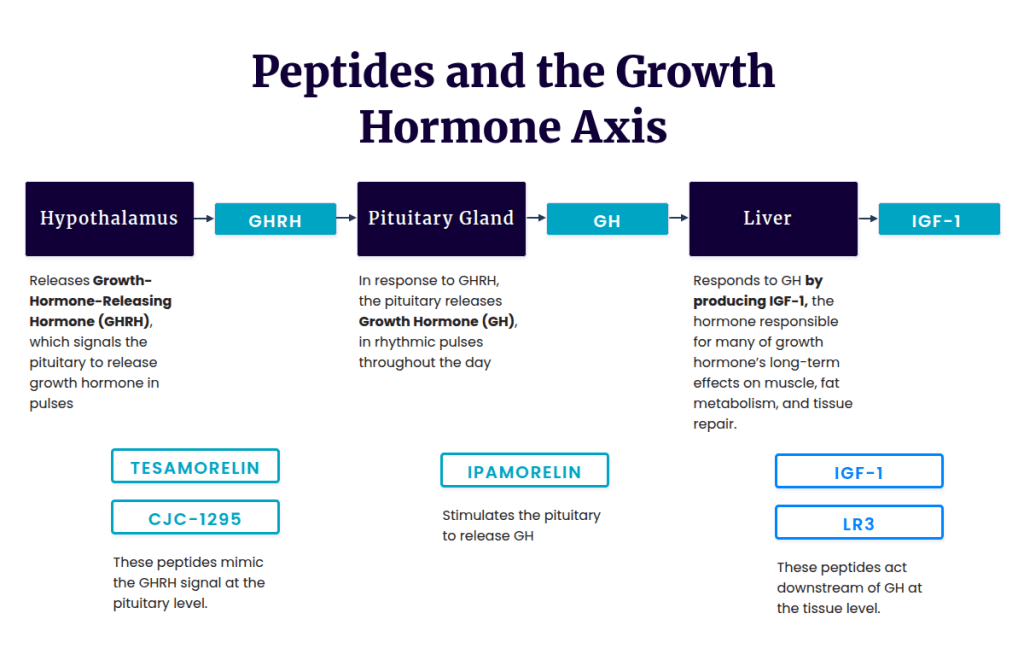
Many peptides for performance are designed to interact with the growth hormone (GH) axis — formally known as the hypothalamic–pituitary–somatotropic (HPS) axis.
The first thing to know is that growth hormone is not released randomly or continuously. It is secreted in pulses through a coordinated signaling cascade:
Hypothalamus → Pituitary → Growth Hormone (GH) → Liver → IGF-1 → Tissue-Level Effects
IGF-1 is responsible for many of the tissue-level outcomes associated with performance:
As we age, GH pulses weaken and become less frequent. Downstream IGF-1 signaling often declines as well. For physically active adults, this can show up as:
Performance-focused peptide therapy works within this axis – either reinforcing upstream signaling or strengthening downstream growth signals.
With that framework in place, let’s examine how each blend fits into structured training phases.
This blend is often the foundation of performance-oriented protocols.
Growth hormone release depends on multiple signaling pathways. CJC-1295 and Ipamorelin work on separate receptors within the pituitary, making their effects complementary rather than redundant.
CJC-1295 mimics growth hormone–releasing hormone (GHRH), the natural signal from the brain that tells the pituitary to produce growth hormone.
Think of GHRH as the “instruction” to make growth hormone. CJC reinforces that instruction.
Because growth hormone stimulates IGF-1 production downstream, strengthening this pathway supports tissue repair and adaptation after training.
Ipamorelin activates the ghrelin (GHS-R1a) receptor at the pituitary — another pathway that stimulates growth hormone release.
While natural ghrelin influences appetite, Ipamorelin is selective. At clinical doses, it stimulates growth hormone signaling without meaningfully increasing hunger or cortisol.
If CJC reinforces the “produce” signal, Ipamorelin supports the “release” signal.
Growth hormone regulation is multi-signal by design:
This pairing works within the body’s regulatory system rather than replacing it. It supports the hormonal environment that allows consistent training to translate into recovery and progress.
Recomposition phases (losing fat while preserving muscle) introduce competing demands.
When calories drop:
This blend addresses those constraints from multiple angles.
AOD-9604 is a small fragment derived from the portion of growth hormone involved in fat metabolism.
In simple terms, it helps signal the body to break down stored fat.
It does not build muscle. It does not override caloric balance. And it won’t cancel out poor nutrition.
Where it becomes useful is during a structured fat-loss phase. When calories are controlled and resistance training is consistent, AOD helps reinforce the “burn” side of the equation — encouraging the body to mobilize stored fat rather than defend it.
MOTS-c works at the level of the mitochondria – the part of the cell responsible for producing usable energy.
When calories drop, energy drops with it. Workouts can feel harder. Output declines. Recovery slows.
MOTS-c supports more efficient fuel utilization at the cellular level. It doesn’t act like a stimulant. Instead, it promotes steadier energy so training quality doesn’t collapse during a calorie deficit.
In recomposition phases, that steadiness matters. Preserving performance is often what preserves lean mass.
Tesamorelin reinforces upstream growth hormone signaling within the axis discussed earlier.
Growth hormone influences systemic fat metabolism and has been studied for its effects on visceral fat — the deeper abdominal fat associated with metabolic risk.
In a recomposition phase, Tesamorelin contributes to the hormonal side of the equation. While AOD works at fat signaling and MOTS-c supports cellular energy, Tesamorelin strengthens the broader endocrine environment that influences how the body partitions fuel.
It’s not about pushing hormones beyond physiologic range. It’s about reinforcing a pathway that tends to weaken over time.
Recomposition introduces multiple constraints. Each peptide addresses a different one:
Together, they coordinate metabolic, energetic, and hormonal inputs rather than relying on a single mechanism.
Fat loss still depends on caloric balance and resistance training. This blend supports the internal conditions under which that work becomes more sustainable.
The previous blends support upstream signaling within the growth hormone axis. This blend acts further downstream.
Instead of stimulating growth hormone release, IGF-1 + LR3 works directly at the tissue level – reinforcing the signal responsible for muscle repair and growth.
IGF-1 (Insulin-Like Growth Factor-1) is produced in the liver in response to growth hormone. Once IGF-1 is secreted into the bloodstream, it then signals muscle tissue to repair and grow.
Sidenote: don’t get hung up on the name. IGF-1 is not insulin and does not regulate blood sugar. The term “insulin-like” refers to structural similarity, not metabolic function.
The main thing to know is that IGF-1 is one of the primary drivers of muscle repair, recovery, and growth.
MOTS-c works at the level of the mitochondria – the part of the cell responsible for producing usable energy.
When calories drop, energy drops with it. Workouts can feel harder. Output declines. Recovery slows.
MOTS-c supports more efficient fuel utilization at the cellular level. It doesn’t act like a stimulant. Instead, it promotes steadier energy so training quality doesn’t collapse during a calorie deficit.
In recomposition phases, that steadiness matters. Preserving performance is often what preserves lean mass.
LR3 is a modified analog of IGF-1, which is designed to remain active longer in circulation. And again, an ‘analog’ is just a term that means it mimics the structure of a peptide.
Natural IGF-1 binds to proteins in the bloodstream that limit how long it stays available. LR3 binds less tightly, allowing it to remain active for a longer period.
IGF-1 acts quickly but clears the body relatively fast. LR3 lasts much longer. The takeaway? Combining the two can provide both an initial signal and a longer window of activity.
Let’s recap on why blending IGF-1 and LR3 peptides for performance a strong option:
And once again, it’s worth mentioning that you can’t take a peptide like this and just expect muscle to grow on its own. The work still counts: progressive overload, protein intake, hydration, sleep, and so on.
If you’re actively researching peptides, you probably still have a few questions. Let’s talk through the common FAQs.
Q1. What are performance peptides and how do they work?
Performance peptides are short chains of amino acids that signal your body to support recovery, fat metabolism, or muscle growth. Many work by prompting the pituitary gland to release growth hormone through the body’s own pathways. At Elite Health HRT, peptides like tesamorelin are layered strategically during defined training phases, with medical oversight throughout.
Q2. How do CJC-1295 and Ipamorelin work together?
CJC-1295 and Ipamorelin stimulate growth hormone release through two separate pathways in the pituitary gland. CJC-1295 mimics what’s called growth hormone-releasing hormone (GHRH). This reinforces the brain’s natural signal, while Ipamorelin activates the ghrelin receptor pathway. Used together, they support tissue repair and adaptation after training by strengthening downstream IGF-1 signaling. A provider determines whether this combination fits your goals.
Q3. What is Tesamorelin used for?
Tesamorelin reinforces upstream growth hormone signaling to influence fat metabolism and how the body uses nutrients. In Elite Health HRT’s inventory of peptides, it appears in a body recomposition blend alongside AOD-9604 and MOTS-c. Together, these peptides are aimed at losing fat while preserving muscle during structured phases with controlled calories and consistent resistance training. As always, our providers determine if they are a fit for an individual patient’s background.
Q4. What does AOD-9604 do?
AOD-9604 is a growth hormone fragment that targets fat metabolism. It signals the body to mobilize stored fat, particularly during a calorie deficit. Elite Health HRT pairs it with MOTS-c and Tesamorelin in a recomposition protocol designed to support fat loss while preserving lean muscle.
Q5. What is MOTS-c and how does it support performance?
MOTS-c works at the mitochondrial level to promote efficient cellular energy production. This helps maintain training performance during a calorie deficit, when energy availability is lower. At Elite Health HRT it is combined with AOD-9604 and Tesamorelin in a body recomposition blend. As with all peptides, a provider determines suitability based on labs and goals.
Q6. What are IGF-1 and IGF-1 LR3 used for?
IGF-1 acts downstream in the growth hormone axis to drive muscle repair and growth. IGF-1 LR3 is a modified analog that stays active longer in circulation, extending the growth signal window. Elite Health HRT’s practitioners use this pairing in patients to reinforce muscle repair during defined build phases. These are goal-specific tools applied within monitored cycles, not continuous therapy.
Q7. How long is a typical peptide performance cycle at Elite Health HRT?
Elite Health HRT structures performance peptide protocols in roughly 10-week cycles, typically administered subcutaneously on a schedule such as 5 days on and 2 days off. Protocols are time-bound and goal-specific, adjusted based on how each patient responds. They are not intended as indefinite therapy, and dosing is set and monitored by a provider.
Q8. Are peptides the same as taking growth hormone?
No. Many performance peptides prompt your body to release its own growth hormone through natural pathways, rather than introducing hormone from outside. We often describe this as working within the body’s regulatory system instead of replacing it.
Q9. Do peptide therapies require lab work and monitoring?
Yes. Elite Health HRT requires medical monitoring that includes lab reviews and body composition tracking throughout a peptide protocol. Dosing is adjusted based on patient response, and medications are sourced from regulated U.S. compounding pharmacies. This oversight helps confirm the therapy is appropriate, safe, and aligned with your goals during each defined training phase.
Q10. Who is a good candidate for performance peptides?
Performance peptides are generally suited to individuals with foundational habits in place, including consistent resistance training, nutrition, and sleep. The peptides are layered to support specific goals like recovery, recomposition, or muscle building during a defined time period. Consultations and lab work helps guide a provider’s determination of whether you are a candidate, and which protocol fits your objectives.
Q11. Where can I get peptide therapy near North Atlanta or Roswell, GA?
Elite Health HRT offers medically supervised peptide therapy at clinics in Roswell and Hickory Flat that serve the North Atlanta area. Care begins with a consultation and lab work so our practitioners can provide guidance for a goal-specific protocol. Medications are sourced through regulated U.S. compounding pharmacies and monitored throughout each cycle.
Peptide therapy for performance isn’t about chasing extremes. It’s about aligning physiology with intention.
Each blend above supports a different phase:
Training, nutrition, and sleep remain the foundation. Peptides are layered strategically — not casually — and only when there is a defined goal.
In our clinic, these protocols are applied within structured phases, monitored alongside labs and body composition tracking, and adjusted based on response.
Serving patients in North Atlanta: free 15-minute consult with licensed provider
Free digital 25+ page ebook with over 1,000 downloads
Did you find this article helpful or informative? Consider spreading the word!
Subscribe now to keep reading and get access to the full archive.