920 Woodstock Rd, Roswell, GA 30075

Typically, people don’t start exploring peptides because they woke up with a newfound fascination in biology. It’s an interesting topic because they can offer support in reaching various health goals. You may have heard of someone online or someone you know personally that found success using a peptide to improve things like recovery, sleep, or fat loss. Perhaps you found your way to this article after hearing a certain peptide like BPC-157 mentioned by name, and it left you wondering what exactly is the deal with peptides.
Curiosity is the right starting point. However, it helps to learn the foundations about peptides – what they are, and how they work – before diving headfirst into all the various peptides the clinical world offers.
This article is the first of four. From here we cover where peptides come from, how to handle choosing a peptide, and we explain the basics of how peptide cycles work. If you’re already comfortable with the basics, feel free to skip ahead.
If you’re looking for a practical explanation of what peptides are, and how they work, you’re in the right place. Let’s get right to it.
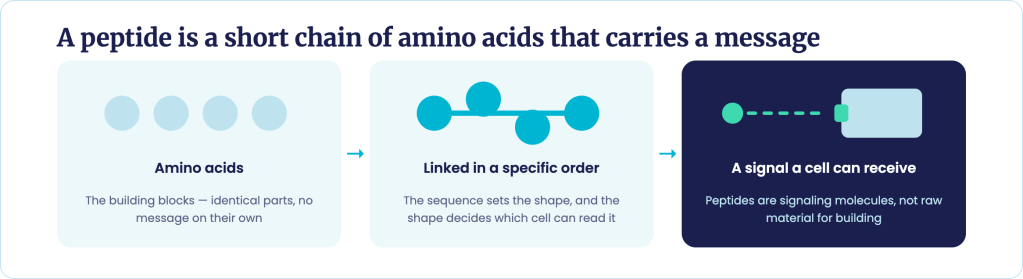
For starters, here’s the somewhat boring scientific definition. Peptides are short chains of amino acids. Even if you weren’t paying attention in high school biology class, you’ve probably heard someone mention, “Amino acids are the building blocks of cells.”
On its own, that’s a bit of a throwaway statement. The real question is, “What does the body build with said blocks?”
By arranging building blocks in different combinations, the body produces thousands of its own peptides. And yes, the body makes natural peptides on a daily basis.
Each of them serves a unique purpose, but all of them have one thing in common. They’re all signaling molecules.
Now you might wonder, “Ok. Signaling what, exactly?”
It helps to explore a few quick examples:
The list goes on and on. As we’ll discuss in this article and others, there are peptides that play roles in all sorts of things like recovery, cognitive function, fat loss, and muscle synthesis.
Note: You’ve more than likely walked past a tub of collagen peptides at the store. Worth clarifying that those are a different category. Collagen peptides are hydrolyzed protein fragments meant to be eaten, and your digestive system breaks them down into amino acids like any other protein. The peptides we’re talking about here are signaling molecules used therapeutically. Same word, different job.
Understanding peptides as signaling molecules is the best place to start. Now let’s talk about how the signals actually work. This helps set the stage for understanding why different peptides support different bodily processes.
Every second of our lives, the body runs on these signals. Hormones, nerves, nutrients, and peptides are constantly ‘telling’ other cells to take specific actions. Like when to grow, when to repair, when to store, and even when to hold back.
So how does a peptide ensure the signal is received? It does so by fitting into what’s called a cell receptor.
That term receptor comes up a lot, so here’s the plain version. Essentially, a receptor works like a lock. A peptide that fits that type of lock is the key. And when the right key meets the right lock, it turns, and the cell receives the signal.
We often compare cell receptors to antennas. That’s partially because they’re actually shaped like little tiny antennas that are on the outside of a cell wall. And similar to a lock that can only be opened with one key, an antenna can only tune into one signal at a time. Same general concept.
The receptor usually doesn’t do the final job itself. It receives the message and kicks off a chain of events inside the cell.
For example, insulin doesn’t personally carry glucose into every cell. It binds the insulin receptor and sets off the steps that help the cell take glucose in. Endorphins don’t reach into your brain and turn down pain by hand. They bind opioid receptors, which changes how pain signals get processed.
Put simply, the peptide delivers an instruction. The receptor receives it. The cell responds.
If insulin, oxytocin, and endorphins are all made from amino acids, why do they produce such different results? It comes down to structure.
The order and arrangement of amino acids set the peptide’s shape. That unique shape then determines which receptors it can fit and what message it delivers.
Let’s go back to the key analogy. Think of two keys cut for two different doors. Same metal, different cut. Only one will have the right shape to open your front door. Similarly, change the amino acid sequence and you may change which receptor a peptide fits. Beyond that, it also changes how tightly it binds, how long the signal lasts, or whether it works at all.
That’s why calling something “a peptide” tells you almost nothing about what it does. It’s like calling something “a medication” without saying whether it’s an antibiotic, an antihistamine, or a blood pressure drug. The category tells you a little. The specific compound tells you almost everything.
A lot of the confusion around peptides starts right here, so stay with us for a moment.
Sending a signal doesn’t guarantee the outcome you want. While a peptide can encourage a biological process, your body still needs the right materials, environment, and capacity to carry it out.
Take recovery for example. A peptide involved in repair signaling doesn’t build healthy tissue out of thin air. Your body still needs adequate protein, circulation, sleep, movement, and time. It may also need whatever caused the injury or inflammation in the first place to be addressed.
The same logic applies to weight loss. A peptide like GLP-1 may influence appetite, blood sugar, digestion, or energy balance, which can make weight loss more achievable. It doesn’t erase every other factor shaping your body composition.
This is exactly why we treat peptides as tools rather than standalone fixes. A good tool can make a real difference, but only when it’s matched to the right job and used as part of a sensible plan. Sorting out whether the job is right is most of the work, which is what the third article in this series gets into.
This part surprises a lot of people. Many peptide medications aren’t foreign substances invented from scratch. They’re modeled on signals your body already uses.
The GLP-1 medications used for diabetes and medical weight loss are a great example. Keep in mind that GLP-1 is shorthand for ‘glucagon-like-peptide-1’. And your gut naturally produces GLP-1 after you eat. Among other things, it helps regulate insulin, blood sugar, appetite, and digestion.
Here’s the thing. Native GLP-1 doesn’t last long in your system. Your body breaks it down within minutes. That’s fine when your digestive system is releasing it in response to a meal, but it’s not very helpful as a medication.
This is why researchers built compounds that activate the same receptor while staying active for far longer. Semaglutide is structurally similar to natural GLP-1. It’s different because it’s modified to resist rapid breakdown and stay in circulation for about a week. Tirzepatide goes a step further by activating receptors for both GLP-1 and a second hormone called GIP. You can find a full deep-dive on GLP-1s in our free guide,
Back to the main point of this section. A medication can be modeled after something your body makes without being identical to it. Those structural changes are the main factor. Some can help a compound last longer, bind more reliably, or reach its target more effectively.
From here, let’s shift gears and take a quick look at how peptides ‘work upstream’ to support natural signaling.
So far we’ve established a few foundational concepts. Peptides are signaling molecules. Each is designed in a way to communicate a specific signal to a specific cell. And the peptides used in peptide therapies are often adjusted in a way that helps the compound work more effectively.
Another key concept to understand when it comes to peptides is what’s called a cascade.
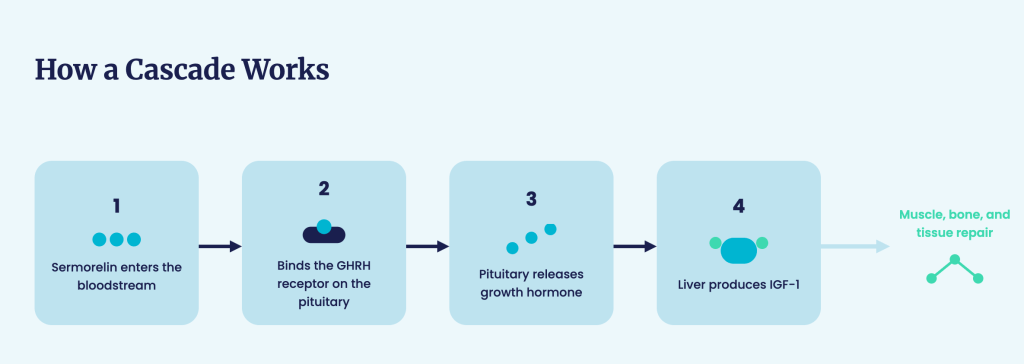
When you think of the term cascade, think ‘domino effect’ or ‘chain reaction’. One action sparks a series of other actions along a multi-step process. The body uses these multi-step processes to create and regulate the amount of hormones, peptides, and other compounds that flow through the bloodstream.
If you’ve read our article on What is the Endocrine System (And Why Even Care), you’ve seen our explanation on how the body uses a feedback loop to control levels of hormones like testosterone and estrogen.
Similar processes control peptide production. As an easy example, let’s explore a peptide called sermorelin that’s commonly used to support energy, recovery, and lean mass.

So first, what is sermorelin? Your hypothalamus produces a hormone called GHRH, which is short for growth hormone releasing hormone. Sermorelin is a lab-made copy of the working end of that molecule. Researchers took the first 29 amino acids of GHRH, which is the portion that actually delivers the message, and left the rest behind.
This now begs the question, “How does a copy of GHRH help with energy and recovery?” Here’s where cascades come in:
IGF-1 is where most of the actual work happens. It’s the molecule that signals muscle, bone, and connective tissue to repair and rebuild.
So count the steps. Sermorelin never touches muscle tissue. It talks to the pituitary, the pituitary talks to the liver, and the liver produces the compound that talks to your muscle. Four handoffs between the injection and the result.
That distance is the whole point of a cascade. Sermorelin doesn’t directly build anything. It starts a series of steps that helps the body do it on its own. It also explains something practical – because IGF-1 shows up on a standard lab panel, we have a real way to check whether the cascade is doing what we expect.
Here’s a mindset we come back to constantly in the clinic. Peptides are tools, not toys.
A good tool can be genuinely useful. Sometimes it’s exactly what the job calls for. But a tool is only as good as the judgment behind it. You have to pick the right one for the job. You have to use it correctly. And you have to know what it can and can’t do.
When it comes to peptides, it’s important to match a peptide therapy to a real goal. It also means being honest when a peptide isn’t the answer. Someone chasing better recovery may actually need more sleep, better nutrition, or a look at an unresolved injury. While someone struggling with weight may benefit from a GLP-1, they may also need help protecting muscle, dialing in protein, or addressing insulin resistance.
Picking the right peptide is an important discussion, and it gets an article of its own in this series. How to Choose a Peptide walks through five questions worth answering before a compound ever enters the conversation. From there, our goal-specific guides go deeper on performance, longevity, recovery and sleep, and focus and mood.
First, we need to talk about another important topic. Where do peptides come from? This is arguably the trickier part.
For most prescriptions, the actual source is a non-issue. Your doctor writes the script, the pharmacy fills it, and what’s on the label matches what’s in the bottle.
Here’s the twist. A large portion of the peptide market doesn’t work like that. The name printed on a vial doesn’t always tell you what’s really inside it. That’s why it’s worth an article of its own.
If peptides sound like they might fit somewhere in your plan, the useful first step isn’t picking a compound. It’s getting a baseline.
At Elite Health HRT, your first consultation is free at both our Roswell and Hickory Flat locations, and that visit includes an InBody scan so you have a starting point to measure against. Comprehensive labs run around $150. Every follow-up visit with our nurse practitioners is free, and we review repeat labs every three months. All of our peptides come from licensed U.S. compounding pharmacies.
There’s no membership and no obligation to start anything. Book a free consultation at one of our North Atlanta locations and we’ll give you a straight answer about whether a peptide belongs in the conversation at all.
Serving patients in North Atlanta: free 15-minute consult with licensed provider
Free digital 25+ page ebook with over 1,000 downloads
Some are, but not all. Insulin, oxytocin, and GLP-1 are peptide hormones. Others act as neurotransmitters, growth factors, or antimicrobial compounds. “Hormone” describes the role a molecule plays. “Peptide” describes what it’s made from.
They’re made from the same building blocks, but peptides are generally shorter chains of amino acids. There’s no single agreed cutoff where a peptide becomes a protein. Both are built from amino acids, but their size, shape, and function can differ a lot.
Many are modeled on substances your body already produces, though the therapeutic versions are often modified to last longer or work more reliably. Being modeled on a natural signal doesn’t make a treatment automatically safe, and being modified doesn’t make it automatically harmful. Your body makes plenty of powerful substances on its own, including insulin and cortisol, and too much or too little at the wrong time still causes problems. Safety depends on the specific compound, dose, evidence, source, and patient.
It depends on the peptide and the outcome. Some signals produce effects fairly quickly. Others, like changes in tissue recovery, body composition, or hormone production, take weeks or months. A quick sensation after an injection also doesn’t prove the intended long-term benefit is happening. It’s the main reason peptides get run on a 10-week cycle with a measurement at the end, rather than taken open-endedly.
The same reason someone might need thyroid support or hormone replacement. Natural production isn’t always adequate, and it changes with age, stress, sleep, and health. A peptide therapy can support signaling that’s fallen off, or nudge a pathway that’s underperforming, without necessarily replacing what your body does on its own.
Yes, and it’s one of the more important questions you can ask. The name on a vial doesn’t tell you the molecule inside is correct, accurately dosed, sterile, or undegraded. A peptide from a licensed U.S. compounding pharmacy and one from an online research vendor are not the same product, even when the labels read identically.
It depends on the goal, your health history, what you’ve already tried, and the evidence behind the specific peptide. We built a five question framework for working through exactly that. Peptides tend to work best when matched to a clear objective and used as part of a larger plan. At Elite Health HRT, the first consultation is free at our Roswell and Hickory Flat locations, so you can talk through your goals and get a straight answer before committing to anything.
Did you find this article helpful or informative? Consider spreading the word!
Subscribe now to keep reading and get access to the full archive.