920 Woodstock Rd, Roswell, GA 30075

If you had a chance to read our initial article on peptides, you already learned the basics. We covered what they are and how they work. You also learned what makes peptide therapy different from the peptides your body already makes.
Once the foundational science begins to click, a new set of thoughts tends to come to mind.
“So where do I actually get peptides? A quick Google search turns them up all over the internet for a fraction of what a clinic charges. Why not just order from one of the sites that doesn’t require a prescription?”
All are fair questions. And it’s not as if the premise behind them is incorrect. To be fair, peptides can be purchased online without a prescription, often for well below what any clinic charges. This raises another question. If the molecule is the same either way, why pay more for a peptide from a clinic?
Here’s the distinction. Oftentimes, the molecule itself is the same. What differs is everything that happened to it before it reached the vial.
To properly compare the differences, it’s important to familiarize yourself with the three separate supply chains that feed the peptide market.
If you examine the peptide market, you’ll find options supplied from three distinctly different supply chains.
The first is what you might hear referred to as pharmaceutical peptides. These are from US compounding pharmacies, which prepare peptides against a prescription written for a specific patient. For the sake of discussion, we’ll call these ‘Prescription Peptides‘.
The second are direct-to-consumer research peptides. These are the ones labeled, “For research use only, not for human consumption.” You might hear other discussions refer to this supply chain as ‘Research Peptides‘.
Third, there’s ‘Black Market’. These are illegal counterfeit medications sold as the real thing. Where research sellers tell you plainly that their peptides are not for human consumption, these claim they are and lie about it.
Let’s dig a bit deeper on each.

“Compounding pharmacy” is a term that’s often thrown around loosely. Let’s clear the air.
They’re fully licensed by a state’s Board of Pharmacy. Each is subject to inspection and fills prescriptions written for specific patients. It helps to know that compounding pharmacies don’t manufacture any of the ‘raw materials’. Instead, they source raw peptide powder from suppliers who are registered with the FDA and obtain documentation on that material.
From there, they prepare peptides in a controlled environment to fill prescriptions. Compounding pharmacies use sealed rooms with filtered air, and they confirm everything is sterile and accurate before anything ships.
Everything is traceable, too. The pharmacy keeps records of which batch went to which patient, so if any sort of issue were to arise, they can be found and pulled.
There’s one other important point that we’ll come back to later. Pharmacies fill prescriptions, which means a provider evaluated you before anything was dispensed.
There’s a common label that is a clear tell. If you see a label on a website that reads something like, “For research use only, not for human consumption,” you know it’s a research peptide.
They’re sold direct to your door for a fraction of clinic pricing, and no prescription required.
The label reads like a throwaway statement. But it does a lot of heavy lifting. In fact, it’s the entire legal foundation that the research peptide market rests upon.
It’s because the product isn’t sold as a medication. Technically, it’s why no prescription is required and they can ship directly. While it seems convenient, it’s important to realize research chemical manufacturers are not bound to the same sort of inspection processes and oversight.
To ease this concern, most sites will post what are called certificates of analysis. On the surface, they look like legitimate documents from credible labs.
Here’s the nuance.
The chemical manufacturers are the ones who commission the tests, choose a sample, and decide which tests to run. And it’s not as if they have to publish the results if they fail a test. There’s also no guarantee the ‘certificate’ aligns to the vial that shows up at your house.
Counterfeit products tend to get lumped in with research peptides, but it’s an entirely different animal.
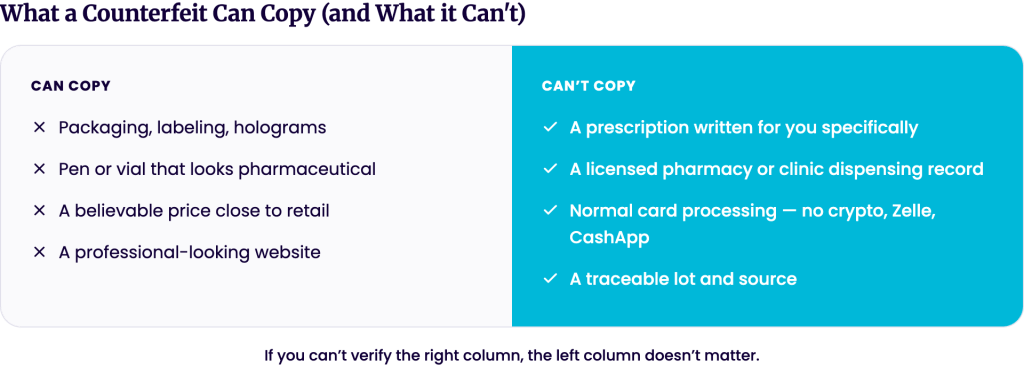
These are medications relabeled or manufactured to pass as the real thing. You might see weight loss pens with convincing packaging or vials dressed up to look pharmaceutical. They’re presented as though a pharmacy handled them, but none did.
One assumption worth correcting is that counterfeits typically aren’t cheap. A pharmaceutical product offered at ninety percent off isn’t believable, and the fraud depends on being believed. That’s why they’re often priced close enough to the real thing to pass. What you’re buying is unknown contents with no traceability whatsoever. There are numerous cases of counterfeit weight loss pens and peptides putting people in the hospital because the vial contained an entirely different medication than what the label claimed.
So if they’re not as obvious as research peptides, how do you avoid them?
Sourcing legitimate medication is boring, and that’s the tell. A pharmacy fills a prescription written for you, or a clinic dispenses it directly. There isn’t a third way.
Payment makes it obvious. Real pharmacies process cards normally. If someone wants payment via crypto or something like Zelle or CashApp, they’re avoiding a trail. That’s almost always your answer.
You don’t need to memorize which vendors are legitimate. Here are four questions that will help you sort any source you come across.
Certificates of analysis answer this very question. That’s why compounding pharmacies and chemical manufacturers alike present them. They confirm the material is the compound it claims to be and measure what else came along with it.
Just remember it’s the minimum. This is the cheapest question to answer and the easiest to pass. Purity testing is routine and inexpensive. Research sellers decide when to run it, and nothing obliges them to publish a result they don’t like.
So it’s not like a certificate. It only answers the one question that costs the least to answer, and none of the next three.
Purity describes the peptide that’s present. However, it says nothing about how much peptide is present. It’s very easy to conflate the two, but they’re two entirely separate measurements.
A vial can be legitimately 99% pure and still have more or fewer milligrams than what’s printed on the label. A purity number can’t tell you whether it’s accurate.
Compounding pharmacies verify the amount because your prescription specifies a dose, and dispensing something other than what was prescribed is a licensing problem.
This contrasts with research peptide manufacturers. They’re not bound to the same scrutiny because their labels clearly emphasize the peptides are not for human consumption.
A powder can be chemically immaculate but still be unsafe to put in your body. Here’s why.
Every time a powder gets handled during the manufacturing process, there’s an opening for bacterial contamination. Sterile manufacturing exists to control this. However, it’s expensive precisely because controlling it is difficult.
Bacteria carry substances in their outer wall that stay behind after the bacteria themselves are dead. These are known as endotoxins. Now, killing the bacteria doesn’t remove them. If you inject enough, you can experience fever, hard shaking chills, and a drop in blood pressure within hours. This is a common cause for most of the peptide hospitalizations you might read about.
The usual reassurances miss this entirely. When peptide powders are mixed with bacteriostatic water in the vial, this only prevents bacteria from multiplying further. That’s very important, but it does nothing to address what was in the powder before the water was added.
Sterile preparation and testing are a large part of what a licensed pharmacy does. They’re also a large part of what the cheaper route skipped.
The first three questions are about the vial. This one is about you. And no research chemical supplier can answer it because they remove medical professionals from the equation.
Knowing what you’re after is the easy part. Goals like getting better sleep, faster recovery, or help with body composition are usually clear enough.
The question of which compound actually fits – and at what dose – is a different one entirely. That answer depends on factors like lab work, your health history, and any other medications you may be taking.
It also doesn’t end at the first dose. A provider doing this properly repeats labs and other measurements to track progress and catch any potential problems early. Also, a provider who knows your history can determine when to adjust, when to cycle off, and when something isn’t working well enough to keep going.
Choosing well is involved enough that it deserves its own discussion, and we’ll head there in the next article.

Peptides can absolutely be bought online for less, and the molecule may well be identical to what a pharmacy would prepare.
All of that verification costs money, and it accounts for most of what separates clinic pricing from what you’ll find online. You’re paying for confirmation of how much is actually in the vial, confirmation that it’s sterile, and a provider paying attention to how your body responds as time goes on.
At Elite Health HRT, our peptides come from a licensed U.S. compounding pharmacies. Your first consultation is free. Comprehensive labs run around $150, and all follow-up visits with our nurse practitioners are free as well. We review labs every three months.
If you’re weighing peptide therapy seriously, book a free consultation at one of our North Atlanta locations in Roswell or Hickory Flat. Feel free to bring these four questions with you and ask us all of them.
Serving patients in North Atlanta: free 15-minute consult with licensed provider
Free digital 25+ page ebook with over 1,000 downloads
For the buyer, generally no. Sellers stay outside of drug regulation by labeling the product for laboratory use, which is what lets them ship without a prescription. Legal and verified aren’t the same standard, though. Nothing about that arrangement means anyone confirmed what’s in the vial.
No. FDA approval applies to specific drugs for specific uses after clinical trials, and most peptides haven’t gone through that process. A compounded peptide is prepared by a state-licensed pharmacy under sterility and quality standards, which is meaningful, but it isn’t approval and we won’t present it as such.
It does. The raw powder arrives with documentation and the pharmacy is trusting it the same way anyone would. What’s different is everything after that point. The pharmacy confirms its own finished preparation is sterile and accurately dosed, a state board inspects those records, and it can’t quietly skip a result it doesn’t like.
For most peptides used in clinical settings, side effects are fairly limited. Redness or irritation at the injection site is the most common. Some people notice mild nausea, temporary water retention, or tingling in the hands, particularly with the growth hormone secretagogues. Most of it is dose dependent, which is one more reason accurate dosing and follow-up matter.
The molecule isn’t what you’re paying for. You’re paying for raw material from a registered supplier, sterile preparation in a licensed facility, verified dosing, a prescription based on an actual evaluation, and lab work that continues after you start. Remove all of that and the price drops considerably, which is exactly what the cheap vial has done.
Did you find this article helpful or informative? Consider spreading the word!
Subscribe now to keep reading and get access to the full archive.