
920 Woodstock Rd, Roswell, GA 30075
WOMEN'S HEALTH & WELLNESS

Est. Reading Time: 4 Mins
Discussions on birth control often devolve into heated philosophical debates. To be clear, the goal of this article is to explore the potential health implications that synthetic birth control has had on women’s health over the last ~60 years, and continues to have today. Specifically, we’ll focus on a nuanced review of topics like overprescription, impact on women during developmental years, and the potential for causing hormonal imbalances later in life.
The first birth control pill was introduced to American society in the early 1960s with the arrival of Enovid 10, a mix of synthetic forms of the hormones estrogen and progesterone. As it hit the market, pharmaceutical companies invested millions of dollars pushing marketing campaigns to popularize the term, ‘The Pill’.
By the mid-1960s, over 27% of American women reported using the first birth control pill – which equates to roughly 26 million women in total (NIH). In the 1980s, formulations largely shifted to ethinyl estradiol (EE2), which was a new synthetic form of estrogen. Newer variations have been developed in the following decades, most of which still contain progestins (a synthetic form of progesterone). Both synthetic hormones have been linked to a variety of health concerns as we’ll explore later in this article.
As of 2024, about 14% of women still use oral birth control. When you account for the rise in the USA’s population growth, it still equates to roughly 25 million women across the country (CDC).
While birth control pills were originally touted as a method for family planning and preventing unwanted pregnancies, manufacturers’ marketing campaigns were quick to promote other clinical applications. G.D. Searle & Co. (the creators of Enovid) advertised the Pill as a means to postpone menstrual cycles to more convenient times (NIH). Soon after, manufacturers also advertised the Pill as a practical application for treating acne, menstrual syndrome (PMS), and premenstrual dysphoric disorder (PMDD).
By the 2000s, manufacturers began launching even more sophisticated campaigns. Companies like DuraMed were among those that targeted physicians with relentless in-person visits, educational materials, and sample kits in their practices. They also launched some of the largest direct-to-consumer campaigns in both print and digital media.
It’s worth noting that the USA is the only country in the world that permits the advertisement of pharmaceuticals, aside from New Zealand. While this was permitted well before the 60s, the marketing strategies developed for the Pill significantly influenced the evolution of laws surrounding advertisements.
In large part, regulatory decisions surrounding the Pill paved the way for pervasive pharmaceutical advertisements across print, digital, radio, and other mediums.
While it has its merits, this is what ultimately raised concern of overmedication with drugs like birth control pills – especially amongst young women.
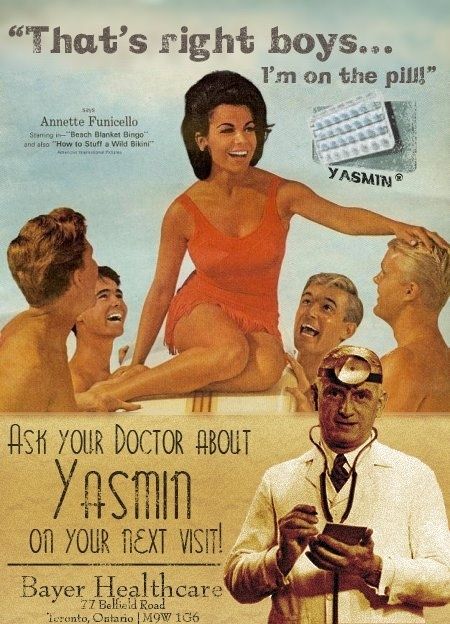
According to CDC statistics, roughly 20% of American women ages 15-29 reported they currently used the Pill (CDC). Here’s why this is troubling news. A study conducted on over 1 million women in Denmark found that adolescents ages 15-19 using oral contraceptives were 80% more likely to start taking antidepressants (JAMA).
Now, consider that for a moment. Isn’t it a bit strange that a pill to help teens treat PMS, PMDD, and acne during puberty would lead to such a troubling increase in rates of depression later in life? Not only that, depression isn’t the only potential consequence of using birth control pills with synthetic hormones.
Here are other known side effects:
The results of the same Danish study mentioned earlier also found that women taking synthetic hormones for contraception for 10+ years had a staggering 40% higher risk of developing breast cancer. For women past their 40s, they also developed higher risks for cardiovascular complications like clots, strokes, and other acute events.
The fact that medical providers are quick to hand out prescriptions has led to a false – and widespread – sense of safety. It’s important to realize that the ‘science’ around birth control has largely been influenced more by pharmaceutical advertising rather than meaningful research focused on improving women’s health.
For many women, getting on the Pill for symptoms like acne or PMDD isn’t going to fix the symptom. It will simply mask it – and it often fails to do so in the long term. In fact, it often leads to downstream side effects that mainstream medicine is quick to treat with SSRIs (antidepressants), stimulants, and other powerful drugs. Each has their own sets of side effects that providers often fail to properly inform their patients about.
Fortunately, there are safer ways to reduce the chance of an unwanted pregnancy (which are outside the scope of this article), making it that much more important to reconsider the potential complications of birth control.
Still, it’s one thing to ring the alarm bells. Let’s shift our attention to explore the reasons behind the risk.
Insights from Dr. Lindsey Berkson
Dr. Lindsey Berkson, a renowned hormone expert, emphasizes that the introduction of synthetic hormones during critical developmental years can disrupt the natural hormonal balance. She points out several key concerns:
The Women’s Health Initiative (WHI) study brought significant attention to the risks associated with hormone replacement therapy (HRT). Similar to birth control pills, synthetic hormones used in HRT were found to increase risks for breast cancer, heart disease, and stroke. However, bioidentical hormone replacement therapy (BHRT), which uses hormones that are chemically identical to those the body produces naturally, can offer a much safer alternative to restore hormones to proper balance.
Oftentimes, women who are experiencing symptoms of hormone imbalance are hesitant to investigate bioidentical hormone replacement due to the misconception that BHRT can lead to various health implications. While science has plenty of valid concerns about synthetic hormones, bioidentical hormone replacement is actually shown to be protective against health risks (Berkson).
Originally, hormone replacement therapy was largely targeted towards women experiencing symptoms of menopause in their 40s and 50s. While this is still a common and practical clinical application, women are starting to experience symptoms of hormone disruption in their 20s and 30s. To be fair, this is due to factors aside from synthetic birth control, which are reviewed in “Endocrine Disrupting Chemicals: 5 Things You Need to Know”.
There’s no denying that women’s health is in a more fragile state than it was in previous generations. This is easily demonstrated by rising rates of PCOS, infertility, thyroid disorders, and so on. While it’s difficult to assign a specific level of responsibility to synthetic birth control, they’re certainly a contributing factor.
At Elite Health HRT, we specialize in helping women balance their hormones and unlock a higher quality of life. If you’re experiencing one or more of the symptoms listed above, you can book a free consultation with our nurse practitioner at our clinic in Roswell, GA.
For new patients, the journey starts with 15-30 minute appointment to discuss your symptoms. During your first visit, we’ll also collect a few blood samples for comprehensive testing. On your follow-up visit, our NP will review your lab results with you and share recommendations on treatment if you’re a candidate for HRT.
We only charge $125-$150 for initial labs (compared to $500 or more for most clinics in Atlanta) and there’s no obligation to start therapy after your follow-up appointment. If you’d like to schedule a time, simply use the link below.
In-person consult with our lead nurse practitioner (15 mins)
Did you find this article helpful or informative? Consider spreading the word!

What's the real story? Learn about the science-backed benefits and dispel common myths

Do GLP-1's like semaglutide really work as advertised? Are they actually safe?

Our lead NP, Kitty Houston, joined Business RadioX for a talk on HRT and holistic approaches to health.
Subscribe now to keep reading and get access to the full archive.