
920 Woodstock Rd, Roswell, GA 30075
HEALTH TIPS & FAQ'S

Est. Reading Time: 5 Mins
For men and women with low or imbalanced hormone levels, Hormone Replacement Therapy (HRT) can make a life-changing difference. First, understanding the potential need for HRT begins with recognizing its signs. If you’re unsure whether you may be a fit for hormone replacement, then you will likely find our guides, “Women’s Wellness Alert: 13 Signs of Hormone Imbalance” or “Know the Signs: The Top 9 Symptoms of Low Testosterone in Men” to be helpful. The resources outlines the key indicators of hormone deficiencies and reviews how HRT can potentially help.
Once you’re aware of these symptoms, one the of the next steps is to examine the various delivery methods of hormone replacement. While others are becoming available, we’re going to focus on the 4 most common forms – patches, injections, creams, and pellets.
At Elite Health HRT, it’s quite common for our new patients to ask, “Which form of HRT is best?” The optimal choice really depends on the criteria you’re using to decide. As a patient evaluating any therapeutic, it’s always important to examine the pros & cons.
For each method, we’re going to examine the five following considerations:
By carefully comparing the following 5 criterion, patients can select a HRT method that not only meets their therapeutic goals but also aligns with their personal health considerations and lifestyle. Plus, by making an informed decision, you’re far more likely to reach a satisfactory treatment outcome.
The effectiveness and consistency of testosterone absorption into the bloodstream are vital for achieving and maintaining optimal therapeutic levels. This evaluates how well each HRT delivery method facilitates stable testosterone levels over time, directly impacting the overall success of the treatment.
Factors such as the rate of absorption, peak levels achieved, and the maintenance of these levels between doses or applications play a critical role in ensuring that patients experience the intended benefits of HRT without significant fluctuations that could affect mood, energy, and physiological functions.
Convenience assesses how seamlessly a HRT regimen can be integrated into a patient’s daily routine. Naturally, this heavily influences patient adherence and overall satisfaction with the treatment. This involves considering the frequency and ease of application, the need for ongoing medical appointments, and the lifestyle adjustments required for each delivery method.
A treatment that aligns with the patient’s lifestyle and personal preferences is more likely to be used consistently, making convenience a crucial factor in the long-term success of HRT.
The ability to fine-tune the dosage of testosterone is essential for individualizing treatment to meet each patient’s unique hormonal needs. Adjustability allows HRT providers to modify doses based on changes in symptoms, shifts in lab results, and individual response to therapy.
This flexibility is critical for optimizing treatment outcomes, minimizing side effects, and responding to the evolving needs of the patient over the course of treatment. A delivery method that offers high adjustability can better accommodate the nuances of individual hormone profiles and lifestyle changes.
When examining cost, it’s important to consider both the initial and ongoing expenses associated with the chosen delivery method. This includes the weekly/monthly cost of the HRT therapy itself, the cost of period lab work, and the potential fees for medical consultations and procedures.
At Elite Health HRT, we advocate for the use of intramuscular (IM) injections as our primary method for administering testosterone replacement therapy (TRT). Our clinical experience and patient outcomes have led us to favor this approach due to its superior efficacy in achieving and maintenance of optimal testosterone levels.
Our commitment is to provide effective, personalized care, and IM injections have proven to be an indispensable tool in fulfilling that commitment.
Patches provide a non-invasive way to deliver testosterone through the skin. This is typically seen as a lower-risk alternative than gels & creams. Patches are also far less invasive than pellets, which require a procedure to be implanted under the skin.
In the right conditions, this can offer consistent daily absorption. However, this can be less predictable than using injections since multiple factors can affect absorption (skin conditions, weather, exercise, etc). From a providers point of view, this makes it more difficult to adjust the dose for maximal benefit.
Grade: Suboptimal
On the surface, patches are quite user-friendly (pun intended). However, patches and creams need to be applied on a daily basis, which can be a bit of a chore over time. Also, for patches in particular, you’ll need to change the application site every single day.
If you face any issues with patches peeling off or have difficulty absorbing the therapeutic through the skin – you can quickly trade convenience for disappointment. Also, if you’re prone to skin irritation like eczema or psoriasis, patches and creams can aggravate the condition.
Grade: Average
While testosterone patches do offer a measure of convenience, they fall slightly short in terms of dosage flexibility. Unlike injectable forms of TRT, patches have a predetermined dosage, which may limit the ability to fine-tune treatment based on evolving patient needs.
Grade: Suboptimal
Even with savings from GoodRX, a 30-day supply of Androderm can easily run more than $600. By comparison, this is more expensive than a 90-day TRT treatment at Elite Health HRT.
Typically, HRT is not covered by insurance. This is because the range for ‘normal’ testosterone levels is artificially wide and is clinically ‘normal’ when between ~275-1,000 mg/dL for men and ~10-50 mg/dL for women.
Grade: Highest
Intramuscular injections allow for precise dosing adjustments, ensuring that each patient receives a treatment tailored to their specific needs. While we recognize that injections may not be the preferred choice for everyone (particularly those with an aversion to needles) we’ve found that the benefits tend to far outweigh the concerns.
When IM injections are properly administered, the entire dose is guaranteed to enter the body. This ensures you’re receiving an appropriate and consistent dose of testosterone. At Elite Health HRT, we use a form of testosterone known as testosterone cypionate. Once administered, it tapers off over a 7-day period – which makes it ideal for weekly injections.
However, some providers prescribe much larger (and sometimes unsafe) doses of testosterone on a 2-week basis. This is something to avoid, as you’d experience a large ‘peak & valley’ effect. We do not recommend working with a clinic or doctor that tells you to take a ‘double-dose’ dose of testosterone every other week. It’s far safer and more effective for patients to receive a dose once a week.
Grade: Ideal
While it’s simple to apply a testosterone patch or gel/cream, some patients find it tiresome to deal with it on a daily basis. And while the slight pinch of an IM injection might not be the most pleasant part of your week – it’s simple, reliable, and highly effective.
Most clinics, like Elite Health HRT, also offer weekly treatments if you or a member of your household are not comfortable administering the dose at home. For many patients, weekly IM injections become a part of the weekly routine. If you weigh the ‘chore’ of a weekly injection against dealing with the symptoms of low testosterone – it’s a very fair tradeoff.
Grade: Average
The effectiveness of IM injections are much easier to measure for providers, especially given the much higher absorption. In terms of adjustability, it’s also far easier for providers to modify the dose amount/frequency than with implanted pellets. This results in a favorable grade for IM injections.
Grade: Optimal
Large increases in demand for testosterone cypionate has resulted in large-scale increases in production by compounding pharmacies. As a result, the cost for this delivery method averages between ~$115 – $200 per month. This, of course, depends on the provider. For patients switching to Elite Health HRT to other Atlanta-based clinics, we commonly hear they’re able to save money without sacrificing the quality of their care.
Grade: Ideal
When examining all four delivery methods, it’s extremely important to consider the potential of 1) transferring the testosterone to others through physical contact and 2) potential complications at the application site.
With IM injections, there’s absolutely zero risk of transference. This grades out more favorably that creams & gels. While some patients do report mild swelling after some injections, this tends to subside quickly.
Right now! In all seriousness, it’s never a bad idea to at least check your hormones through a comprehensive blood panel. If nothing else, at least you’ll have a baseline for later in life.
Labs for new patients cost $150; no obligation to begin treatment afterwards
Creams, like Androgel are applied topically, which allows testosterone to be absorbed through the skin. They are typically prescribed for daily application.
While testosterone creams are easy to apply, their absorption rate can be less predictable compared to other forms of HRT. The skin’s ability to absorb the hormone varies among individuals, and factors such as skin thickness and the area of application can influence effectiveness. As a result, achieving stable testosterone levels might require regular monitoring and adjustments.
As a complicating factor, creams can also rub off on others through skin-to-skin contact (such as simply giving a friend or family member a hug). For obvious reasons, this can be quite dangerous.
Grade: Suboptimal
Despite the risk of unwanted transference to others, one of the major advantages of testosterone creams is their convenience. They can be easily applied to areas like the shoulders, upper arms, or abdomen. This makes them an appealing option for individuals with an aversion to needles or more invasive methods like pellets.
Grade: High
The adjustability of testosterone creams is somewhat mixed. On one hand, dosage adjustments can be made relatively easily by altering the amount of cream applied. On the other hand, the variability in absorption can make fine-tuning the exact dosage more challenging. Regular blood tests are essential to ensure hormone levels remain within the desired range and to make any necessary adjustments. This inconsistency can be frustrating for patients seeking precise control over their hormone levels.
Grade: Suboptimal
While costs can vary, testosterone creams are usually more affordable compared to patches or pellets. This makes them an attractive choice for those who need a cost-effective solution. Insurance coverage and the availability of generic versions can further reduce out-of-pocket expenses, making this form of HRT accessible to a broader audience.
Grade: Ideal
Pellets are inserted subcutaneously (under the skin) and release testosterone over 3 to 6 months. They’re roughly the size of a grain of rice, and are implanted with a minimally invasive procedure.
Testosterone pellets are designed to release the hormone steadily over time. However, absorption rates can be inconsistent due to factors like pellet placement and individual physiological differences. This can lead to fluctuating testosterone levels, making it challenging to maintain optimal hormone balance.
Grade: Unreliable
In terms of convenience, testosterone pellets rank the lowest. The procedure requires a minor surgical procedure to implant the pellets under the skin, typically in the buttocks or hip area. This must be done by a healthcare professional and usually needs to be repeated every 3 to 6 months. The need for regular procedures and the invasiveness of the method make it less convenient compared to other HRT options like creams or injections.
Grade: Lowest*
*The exception here would be individuals who travel to remote locations on a regular basis. If you’re traveling abroad and won’t be able to bring medication with you, then it might make more sense to consider pellets for a duration of time.
Adjustability is a significant drawback with testosterone pellets. Once implanted, the dosage cannot be easily adjusted until the next implantation. If hormone levels are not within the desired range, patients must wait until the pellets naturally dissolve or require another procedure to remove or add pellets. This lack of flexibility can be a major inconvenience for patients needing precise dosage adjustments.
Grade: Lowest
Price for pellets can vary greatly depending on the provider. If you look long enough, you should be able to find one that can deliver the treatment for an average of ~$100-200 / month. However, this almost always come in lump sums of $650-$1,000 since pellets typically last from 3-6 months.
Grade: Normal to High
Grade: Suboptimal
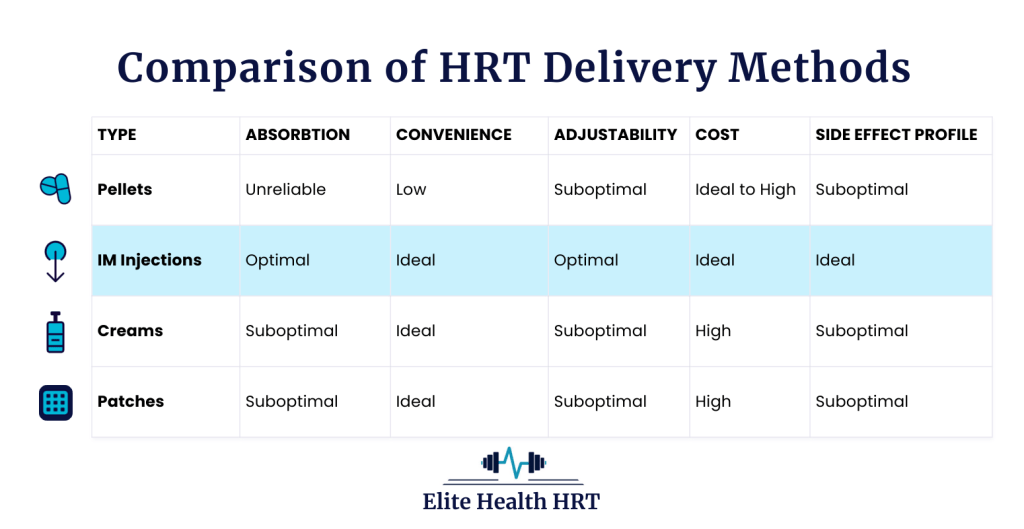
At Elite Health HRT, we recognize every patient is unique and there’s no ‘one-size-fits-all’ solution when it comes to hormone replacement. When compared to other HRT delivery methods, research and years of clinical experience have shown that intramuscular (IM) injections provide the most reliable and effective results.
Remember, it’s important to be your own advocate as a patient! At the end of the day, it’s ultimately your choice to decide which therapeutic is best for you. If you’re still unsure about which option makes sense for your health journey, you can book a free in-person consult with our lead nurse practitioner to discuss further.
Walk-ins also welcome at all clinics

New to peptide therapy? Download our free guide to learn about the science behind it

Newsflash: Age isn't the only reason men are experiencing hormone imbalance in 2024

If any of these sound familiar, consider it a sign to get your hormone levels checked
Subscribe now to keep reading and get access to the full archive.