920 Woodstock Rd, Roswell, GA 30075
HEALTH TIPS & FAQ'S

Est. Reading Time: 6 Minutes
It’s not a well-kept secret. The U.S. population has been grappling with increasing rates of chronic disease, fertility challenges, and hormone imbalance for years. We could examine plenty of reasons why the United States spends $4.4 trillion dollars per year on healthcare, but a great place to start is with a discussion on “how to minimize hormone disruption.”
Most of the time, conventional wellness advice sounds like “Eat less processed food. Consume more high quality protein. Take this supplement. Stop smoking. Minimize alcohol. Lift weights. Get your 10k steps in per day. Make sure you’re sleeping enough.”
Here’s the issue. Many people follow those guidelines and still have challenges because they had no idea they had an underlying hormone imbalance. It’s important to examine what factors can cause this to begin with.
In this article, we’re going to examine 9 endocrine disrupting chemicals (EDCs) that are prevalent in today’s society. We’ll also share practical advice on how you can avoid these chemicals and minimize hormone disruption as much as possible.
First, what's the point of minimizing contact with EDCs?
You might also be wondering, “If EDCs are so prevalent in society, why bother trying to avoid them?” Here’s why. By avoiding and reducing contact with EDCs, you can minimize hormone disruption in the body – which can in turn reduce risk of chronic disease and enhance overall health & wellness.
Also, consider this. If enough people start making informed decisions and purchase healthier products, it can drive market demand for safer alternatives. This collective shift can encourage manufacturers to prioritize safer ingredients, which would lead to a reduction in the prevalence of EDCs in consumer products – and a healthier environment for years to come.
Now, let’s dive in.
Plants like soy and lavender produce a defense chemical called phytoestrogens. For these plants, the chemical can be quite helpful in protecting against pathogens (ie. bacteria, fungi, viruses) and insects. However, phytoestrogens are also effective in deterring herbivores (ie. rodents, insects, livestock) from consuming the plants. This begs the question, why?
On a molecular level, phytoestrogens mimic the hormone estrogen, which is produced by both men and women. So, when a food containing phytoestrogens is consumed, the chemical can then bind to a cell’s estrogen receptors. This can disrupt the body’s natural hormone balance and estrogenic signaling.
While phytoestrogens don’t exert effects the same way that natural estrogen does, they can still lead to negative health effects.
Have you ever contemplated the term ‘genetically modified food’ (GMO) and its implications? On the surface, it sounds quite helpful. You’d think GMO’s simply mean they’re resistant to insect & disease, and have a higher crop yield. While this is partially true, GMO’s are also bioengineered to be resistant to dangerous chemicals like glyphosate and atrazine.
This allows industrial farmers to spray chemicals all over the plants as they grow. While this is quite effective for combatting vermin, insects, and weeds – it also means we end up consuming the dangerously toxic amounts.
Both chemicals are widely considered carcinogenic and extremely dangerous – not just for humans, but for animals as well. Unfortunately, over 80 million pounds of atazine are used in food production per year. This pales in comparison to glyphosate at over 300 million pounds per year.
Here’s the takeaway – any food containing grains (bread, pasta, cereal, etc) that’s not considered “USDA Organic” is likely contaminated with pesticides. Even Banza pasta, which is marketed as a ‘health food’, was ranked as the ‘Most Contaminated Gluten-Free Food’ in a study commissioned by Moms Across America
Avoid: Steer clear of conventionally grown grains and grain-based products, such as non-organic bread, pasta, and cereals. These items are highly likely to contain residues of glyphosate and atrazine due to their widespread use in GMO crop production.
Swap: Opt for USDA Organic certified products to ensure that your grains and grain-based foods are grown without the use of synthetic pesticides and herbicides.
Inquire: Always check product labels for organic certification and non-GMO verification. When shopping at farmers’ markets or local health food stores, don’t hesitate to ask vendors about their farming practices and whether their products are free from synthetic chemicals and GMOs.
Before discussing health implications, let’s review a quick history lesson. Back in the days of World War II, there were large scale industrial producers of oils (like cottonseed, linseed, and rapeseed oil – which is a precursor to canola). At the time, these were not intended for human consumption. Instead, they were primarily used as lubricants in machinery and for other industrial purposes.
When the war ended, the need for these industrial lubricants plummeted. So, since the producers couldn’t rely on the defense industry as a customer, they set their sights on the food industry instead. The producers realized they could make further process industrial oils to make canola oil ‘safe’ (with massive air quotes) for human consumption.
If you look online, there’s no shortage of scientific articles and marketing materials touting seed oils as ‘heart healthy’. The truth is more nuanced – and far more frightening. In reality, these industrial oils often contain significant amounts of carcinogens (like benzene), heavy metals (lead, cadmium, antimony) and another hormone disrupting compound known as phthalates.
So while seed oils are cheap and are useful in making ultra-processed foods (UBF’s) in mass quantities, they have very little merit in terms of serving human health.
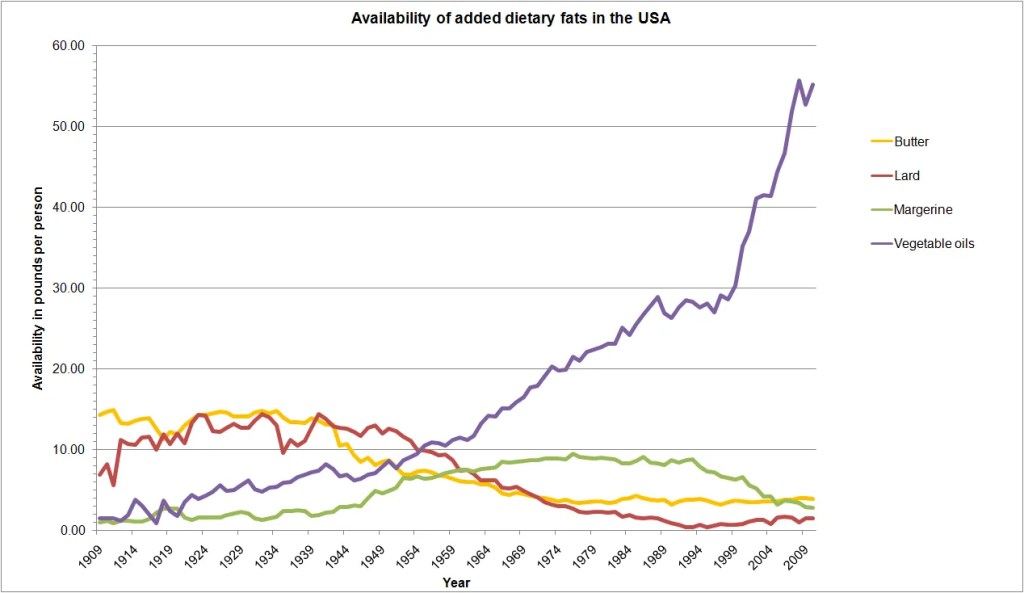
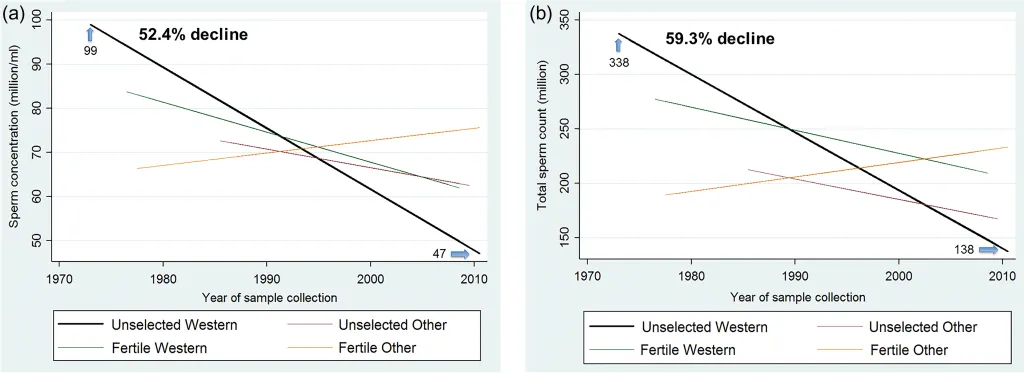
These charts illustrate correlations between the large spike in seed oils in the food supply to sharp declines in male testosterone levels and fertility rates
Synthetic dyes, such as Red40, Yellow5, and Blue1, are commonly added to foods to enhance their appearance and make them more appealing to consumers. This isn’t limited to ultra-processed foods and candies in the middle aisles of the grocery stores. They’re also found in salad dressings and various so-called ‘health foods’. Red40 is even used to make salmon look more fresh in most big-box grocery stores.
It’s worth noting Red40 is banned in Japan. And in the UK and EU, it requires a warning label. No such precautions exist in the US. These dyes not only have carcinogen effects, they also mimic the estrogen molecule and can impact the endocrine system.
On top of that, they have been linked to ADD and ADHD in children because they’re known to upregulate the body’s central nervous system’s intake of dopamine.
Here’s the takeaway – artificial dyes are used to make what would otherwise look like ‘brown mush’ appealing to the brain for consumption. There’s no demonstrable health benefit and they are best eliminated from the diet
Among others, the topic of meat, eggs, and dairy has become a polarizing issue in recent years. While there’s plenty of valid concerns as it relates to factory farming and the treatment of livestock, it’s important to approach the discussion with a sense of moderation.
There are plenty of well-documented benefits from a diet that strikes a balance between consuming organic fruits & vegetables along with responsibly-raised animal products. However, this doesn’t mean that the meat & dairy industry is blameless. Here’s a few key issues to examine:
To protect your health, it’s crucial to minimize your consumption of highly processed meat, dairy, and eggs. Here are some practical strategies.
Have you looked at a label on a bottle of soap and saw the tagline, ‘Paraben-free’? If you’re new to the term, parabens are a class of synthetic chemicals commonly used as preservatives in cosmetics and personal care products. They help extend the shelf life of products and inhibit the growth of bacteria and mold – but their usage comes with a few drawback.
Like the other chemicals we’ve examined, parabens mimic the estrogen molecule. In turn, this can cause hormonal disruption for both men and women.
There’s also an issue regarding bioaccumulation, which means that paraben levels can accumulate in the body over time. This means that even with low levels of use, people are at risk of long-term exposure.
Avoid: Steer clear of personal care products and cosmetics that list parabens among their ingredients. Common parabens to look out for include methylparaben, ethylparaben, propylparaben, and butylparaben.
Inquire: When shopping, read ingredient labels carefully to ensure products do not contain parabens. If in doubt, ask store staff or contact the manufacturer for more information about their preservative practices.
Swap: Choose products that are labeled “paraben-free” and opt for natural or organic personal care items. Look for brands that use alternative preservatives like phenoxyethanol, potassium sorbate, or naturally derived substances such as essential oils.
In recent years, the topic of ‘microplastics’ have captured more mainstream attention. When you hear this term, it’s probably in the context of a class of chemicals known as phthalates (pronounced THA-lates). They’re commonly used in plastics to make them more clear, durable, and flexible. They can also be found in personal care items and household products, such as perfumes and cleaning supplies.
So what’s the issue?
You guessed it – phthalates are also an estrogenic chemical. On a microscopic level, phthalate molecules are so small that they can actually sit between other molecules. When phthalate-containing plastics get hot, the molecules can then easily leech into food or liquids. Once this happens, it’s virtually impossible to remove them.
Of all the estrogenic chemicals, phthalates are incredibly difficult to eliminate altogether given how reliant our society is on plastics. Still, you can dramatically lower exposure with a few suggestions
Avoid: Minimize the use of products that commonly contain phthalates, such as plastic containers, vinyl flooring, shower curtains, air fresheners, and personal care items with synthetic fragrances. Be especially cautious with products labeled with terms like “fragrance” or “parfum,” as these often include phthalates.
Swap: Ditch plastic food containers and choose phthalate-free alternatives, such as glass or stainless steel containers. Also opt for more natural personal care products and household items labeled “phthalate-free” when possible
Inquire: When shopping, read labels carefully and ask about the presence of phthalates in products.
Triclosan is an antibacterial and antifungal agent commonly found in a variety of consumer products such as soaps, toothpaste, and cleaning supplies. While it’s effective at reducing or preventing bacterial contamination, triclosan is also known to be an endocrine disruptor, mimicking estrogen and often leading to hormonal imbalances.
Avoid: Steer clear of products labeled as “antibacterial” or “antimicrobial,” as these often contain triclosan. This includes certain soaps, hand sanitizers, toothpaste, and cleaning products.
Swap: Choose regular soap and water for handwashing, which is just as effective for routine hygiene. Opt for natural or organic personal care products that do not contain triclosan. Look for toothpaste and other hygiene products labeled as triclosan-free.
Inquire: Always check ingredient labels to identify and avoid products containing triclosan. If the information isn’t clear, ask manufacturers or retailers for confirmation.
Ever heard the term, ‘forever chemicals’? This is what they’re referring to. Perfluoroalkyl substances (PFAS) are a group of man-made chemicals that have been widely used in various industrial applications and consumer products since the 1950s. You’ll find them in in food packaging, stain-resistant fabrics, and especially non-stick cookware.
The reason they’re called forever chemicals is because their carbon-fluorine bond is one of the strongest bonds in organic chemistry. This means PFAS does not easily degrade in the environment, which allows them remain intact for decades or even longer.
Some PFAS can dissolve in fats and oils (lipophilic) and others can dissolve in water (hydrophilic). This means that they can store in fat cells, cell tissue, and even the bloodstream. Since these estrogenic chemicals can store up over time (bioaccumulation), long-term exposure can lead to various health issues.
Fortunately, there’s a few practical methods for minimizing PFAS exposure.
Avoid: Limit the use of products known to contain PFAS, such as non-stick cookware, water-resistant clothing, stain-resistant fabrics, and certain food packaging materials.
Swap: Choose PFAS-free alternatives, such as stainless steel, cast iron, or ceramic cookware, and untreated clothing and home textiles.
Inquire: Check product labels and ask manufacturers or retailers about the presence of PFAS in their products. Opt for PFAS-free options whenever you reasonably can.
We know that discussions about the widespread use of endocrine disrupting chemicals isn’t exactly the most heartwarming topic to explore. However, it’s incredibly important to make yourself aware of EDC’s so you can make small adjustments in day-to-day life that can have a positive impact on your health over time.
If you feel as though you’re experiencing symptoms of hormone imbalance (like unexplained fatigue or weight gain, difficulty managing stress, challenges with building muscle, etc), we encourage you to stop by Elite Health HRT.
We start by running comprehensive lab tests and our lead nurse practitioner reviews the results with you in a 1:1 consultation at our clinic in Roswell, GA.
In-person consult with our lead nurse practitioner (15 mins)
Did you find this article helpful? Consider spreading the word!
New to peptide therapy? Download our free guide to learn about the science behind it

Newsflash: Age isn't the only reason men are experiencing hormone imbalance in 2024

If any of these sound familiar, consider it a sign to get your hormone levels checked
Subscribe now to keep reading and get access to the full archive.